Best Sales Force Automation Software for FMCG Brands in India
A buyer’s guide to evaluating SFA for Indian FMCG, and how Vxceed Lighthouse measures up.
Picture the quarter you just closed. The forecast was sound, the trade budget was approved, and the trucks left the depots on schedule. Yet the topline landed below plan, and when you ask why, the answers are vague.
- A region underperformed
- A promotion did not land
- Stock was tight in a few markets
None of these answers is wrong, and none of them tells you what
actually happened at the outlets where the sale is won or lost.
For an FMCG company in India, that fog is expensive. Your products
reach consumers through a distribution network so large and
fragmented that no leadership team can see it directly. Sales
Force Automation (SFA) is the system that helps you clear that fog
and turn millions of individual store visits into a structured,
real-time account of how your commercial plan is being executed on
the ground.
For a brand operating at a large scale in India, the question is
not whether you need it. The question is which system fits the way
you actually sell.
Search for the best Sales Force Automation software, and you will
be handed a ranked list of ten vendors, each summarised in two
lines. That list answers the wrong question. Feature counts matter
far less than fit. This guide sets out the criteria that decide
whether an SFA platform will work for FMCG in India, then shows
how Vxceed’s Lighthouse platform measures up against them. By the
end, you will have a scorecard you can apply to any vendor,
including ours.
The best SFA platform is not the one with the longest feature list. It is the one that fits how your brand actually reaches the market, operates as a growth partner for you, and is there to support you every step of the way.
Why Sales Force Automation is non-negotiable for FMCG in India
The scale of general trade
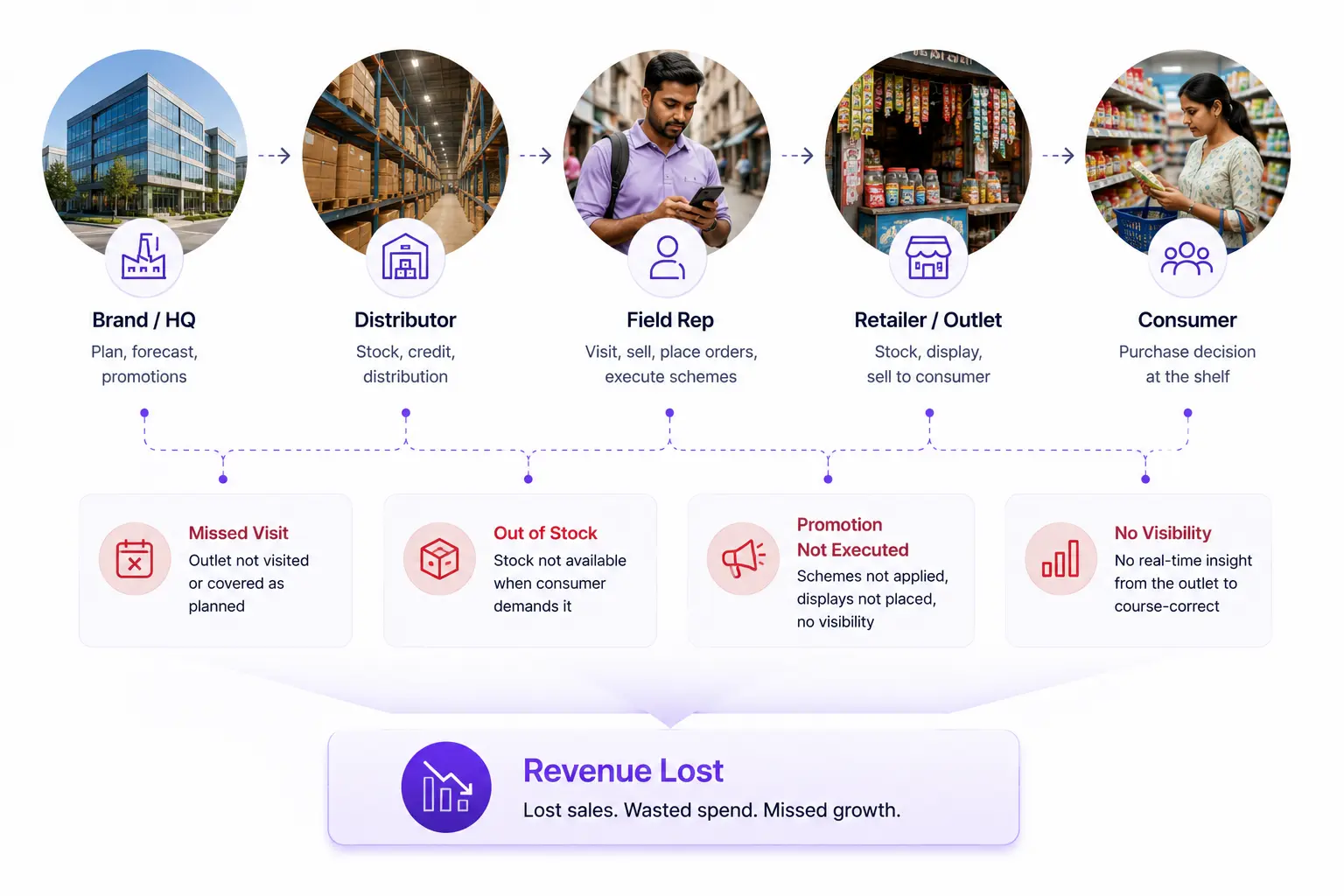
Indian FMCG runs on general trade. More than 13 million kirana stores account for over 90% of the sector’s sales, according to Business Standard, and no modern trade chain or e-commerce platform comes close to that reach. These outlets are served through a layered network, and a typical route to market passes through several hands before it reaches the consumer:
- Brand to super stockist or distributor, who carries stock and credit for a territory.
- Distributor to retailer, through a field salesperson who works a fixed beat of outlets, taking orders, placing schemes, and checking stock.
- Retailer to consumer, at the shelf, where the actual sale is made.
Each layer adds reach. Each also adds a point where execution can drift away from the plan. The field salesperson on the beat is the layer most brands underestimate, and it is precisely the layer that SFA is built to manage.
The execution gap that forecasts cannot close
A good forecast is necessary, but it does not guarantee the sale. Even with strong demand and an accurate plan, revenue is lost at the shelf. Industry research has measured retail out-of-stock rates at around 8% for decades, and NielsenIQ reports that 70% of shoppers will switch to a different brand when their usual choice is missing. The sale does not wait. It moves to whatever is on the shelf instead.
This is the gap that separates planning from results. A missed visit, an unrecorded stock out, or a promotion that never reached the retailer does not announce itself in your reports. It surfaces later as softer numbers with no obvious cause. SFA exists to make that execution visible and manageable, one outlet at a time.
The market you are protecting
The stakes scale with the prize. FMCG is India’s fourth largest sector, generating around US$289 billion in revenue in 2025 and projected to keep growing through 2030, according to the India Brand Equity Foundation. Rural India alone now contributes more than a third of FMCG sales. Growth at this scale does not come from demand on its own. It comes from reach, and from executing consistently across every outlet that drives it.
What weak execution actually costs in a fragmented trade market like India
The cost of poor field execution rarely appears as a single line in a report. It accumulates quietly across the business:
- Revenue leakage. Missed visits and stockouts that are never recorded translate directly into lost sales.
- Wasted trade spend. Promotions funded centrally but not executed at the outlet are spent without a return.
- Decision blind spots. Without a record of what reached each store, leaders infer execution from sales, which is both slow and unreliable.
- Inconsistency at scale. Execution gaps widen as you expand into new territories, because the manual systems that are held in your home market do not transplant cleanly.
A promotion funded at headquarters but not executed at the outlet is not marketing. It is spent without a return.
The eight criteria that define the best SFA for FMCG in India
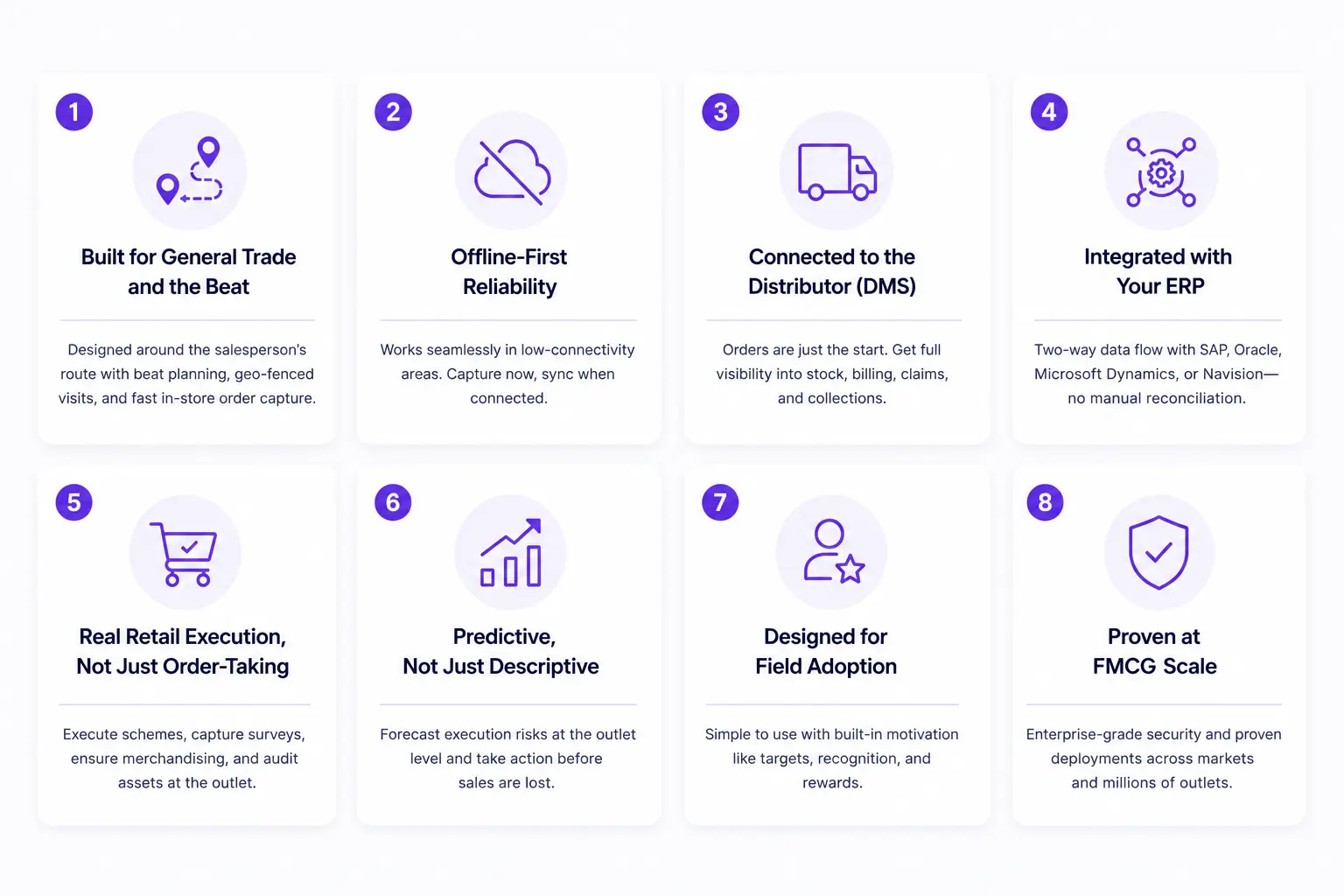
1. Built for general trade and the beat
The system should be designed around the salesperson’s daily route, not a generic CRM workflow. Look for journey and beat planning, geo-fenced visit verification, and fast in-store order capture that a representative can complete in seconds at a busy counter.
2. Offline-first reliability
Field reps work where connectivity is patchy. The app must capture orders, stock, and payments without a live connection, then sync automatically when a signal returns. Anything less means lost coverage in exactly the rural and smaller town markets that drive volume growth.
3. Connected to the distributor (DMS), not a standalone app
Orders are only the start. Without a live link to distributor inventory, billing, and claims, you get activity data but no view of whether stock and money actually moved. The most useful SFA is one layer of a connected system, not an island.
4. Integrated with your ERP
Pricing, schemes, and sales must flow both ways with SAP, Oracle, Microsoft Dynamics, or Navision, without manual reconciliation. Integration gaps are where data quality quietly degrades and trust in the numbers erodes.
5. Real retail execution, not just order-taking
Beyond capturing orders, the platform should apply trade schemes automatically, capture shelf and competitor surveys, check merchandising and planogram compliance, and audit branded assets such as coolers and freezers at the outlet.
6. Predictive, not only descriptive
Reporting tells you what has already happened. Leading platforms forecast which outlets will miss execution and prompt action before sales are lost. This is the capability that most clearly separates a modern platform from a digital logbook.
7. Designed for field adoption
A simple interface and built-in motivation, such as targets and recognition, determine whether reps actually use the system. An SFA tool that the field works around produces no data and no return on the investment.
8. Proven at the FMCG scale
Look for evidence of large, multi-market deployments and enterprise-grade security. A platform that has held up across thousands of outlets and several countries is a very different proposition from one that has not.
Quick evaluation checklist for you
| Criterion | Question to ask the vendor | |
|---|---|---|
| General trade and beat fit | Is it built around the salesperson’s daily route? | |
| Offline-first | Does it work and sync where connectivity is poor? | |
| DMS and distributor link | Can I see stock and money move, not just orders? | |
| ERP integration | Does data flow both ways with my ERP? | |
| Retail execution depth | Schemes, surveys, merchandising, asset audits? | |
| Predictive intelligence | Does it flag failures before they hit sales? | |
| Field adoption | Will reps actually use it every day? | |
| Scale and security | Is it proven at a multi-market scale, certified, and secure? |
How Lighthouse SFA by Vxceed stands out
Lighthouse by Vxceed is an execution excellence partner for FMCG brands, not just a software vendor. Our platform and capabilities are custom-built and mapped to how your route-to-market operates, rather than forcing your operation to fit the tool.
General trade and the beat
Lighthouse handles journey and beat planning, geo-fenced visit verification, and quick in-store order capture, with van sales and pre-sell workflows for the field. The representative’s day is structured deliberately, so coverage is planned rather than left to chance, and managers can see in real time which outlets were visited and what happened at each one.
Offline-first in the markets that matter
The platform is offline-first by design. Representatives in low-connectivity rural and Tier 2 and Tier 3 markets keep capturing orders, stock, and payments without a live connection, and the data syncs automatically when they reconnect. Coverage is not lost in the markets where growth is now strongest.
Connected to the distributor and the trade ledger
Crucially, the SFA does not stand alone. It is connected to the Lighthouse Distributor Management System, so field orders flow into distributor billing, inventory, and the order-to-cash cycle. Trade-scheme spend is reconciled rather than estimated through a digital trade ledger, which removes the claim disputes that erode distributor trust. Distributor teams get the same operational picture, including fill rates, inventory, receivables, and settlement, through Lighthouse Edge, instead of waiting for weekly reports.
Integrated with your enterprise stack
Lighthouse integrates bidirectionally with SAP, Oracle, Microsoft Dynamics, and Navision, so pricing, schemes, and sales stay in sync with the enterprise systems you already run. Orders, ASN data, and replenishment information move between systems without reconciliation lag.
Retail execution beyond order-taking
Execution runs deeper than taking orders. Lighthouse applies trade schemes automatically, captures shelf and competitor surveys, supports merchandising and planogram checks, and, through its asset management module, audits branded coolers and freezers for placement, uptime, and brand purity. The outlet visit becomes a full execution event, not just an order line.
Adoption built into the field experience
For motivation and adoption, the Engage and Gamification layers turn targets into daily missions, recognition, and rewards, so field teams use the system rather than work around it. Adoption is treated as a design problem, not an afterthought, because an unused platform produces no data.
Proven at scale, secured for the enterprise
On scale and trust, Lighthouse runs across 30+ countries, managing over $1 billion in daily sales. It is used by brands such as Coca-Cola Bottlers, Unilever, Parle, Weikfield, L'Oréal, and many more, and runs on AWS-hosted infrastructure certified to ISO 27001 and SOC 2.
From reactive to predictive: the real differentiator
Most SFA systems tell you what already happened: last week’s fill rate, yesterday’s coverage, the visit that was missed. By the time that surfaces in a report, the window to act has closed. The gap in Indian FMCG execution is rarely a shortage of data. It is timing.
This is where Lighthouse Signals separates a modern platform from a digital logbook. Signals is a predictive layer that forecasts which outlets will miss execution against promotion, stock, and compliance targets 48 to 72 hours before that miss shows up in sales. It scores risk at the individual outlet level, not as a chain average, and hands the field team a prioritized, next-best-action list on mobile before they walk in the door.
For a commercial leader, the shift is fundamental. The field team moves from reviewing failures after the fact to preventing them before they happen, and trade spend is protected at the point where it is most often wasted. This is the capability that commercial leaders should now be asking every SFA vendor to demonstrate, not describe.
How to run an SFA evaluation
Choosing an SFA platform is a commercial decision as much as a technology one. A disciplined evaluation follows a clear sequence:
- 1. Map your route to market first. Document your channel mix, distributor tiers, and the realities of your geography before you look at any vendor. The requirements should come from how you sell, not from a feature list.
- 2. Score every vendor against the eight criteria. Use the scorecard above to compare like with like, and weight the criteria that matter most for your business.
- 3. Test offline in a real beat. Insist on a demonstration in field conditions with intermittent connectivity, not a polished boardroom run with full signal.
- 4. Verify the DMS and ERP integration end-to-end. Confirm that an order placed in the field flows through to distributor billing, inventory, and your ERP without manual steps.
- 5. Pilot in a representative territory. Choose a market that reflects your real conditions, including rural beats, rather than your easiest one.
- 6. Measure adoption and execution, not logins. Track whether reps use the system, whether coverage improves, and whether stockouts fall. Usage and outcomes are the only proof that matters.
Common mistakes to avoid
The brands that are disappointed by SFA usually made one of a handful of avoidable errors:
- Choosing from feature lists instead of what fits their route to market strategy the most.
- Treating SFA as a standalone app, disconnected from the DMS and the distributor.
- Underestimating offline reliability and field adoption in rural markets.
- Buying reporting when the business actually needs prediction.
- Skipping the field pilot and trusting the boardroom demonstration..
The bottom line
There is no universal best Sales Force Automation software. The best system for an FMCG brand in India is the one that fits how the country actually buys: general-trade depth, offline reliability, a live link to distributors, ERP integration, real retail execution, and the predictive intelligence to act before sales are lost. Score any vendor against those eight criteria, and the shortlist gets short quickly.
Vxceed Lighthouse is built for exactly that reality, and proven across some of the largest distribution networks in the consumer goods world. The most useful next step is not another feature comparison. It is seeing the platform mapped to your own distribution structure, so the gaps and the gains are concrete.
See Lighthouse SFA mapped to your distribution network. Request a walkthrough with our strategists.
SFA is software that digitizes the work of a field sales team: planning daily beats, verifying outlet visits, capturing orders and payments, applying schemes, and recording stock and shelf conditions. In FMCG, it replaces paper and manual reconciliation with a structured, real-time record of execution across every outlet a brand serves.
More than 13 million kirana stores drive over 90% of FMCG sales through a multi-tier distributor network. Managing coverage, orders, schemes, and stock across that many outlets by hand is unreliable, and the resulting execution gaps translate directly into lost sales.
SFA manages the field sales team and what happens at the outlet. A DMS manages the distributor’s operations, including inventory, billing, claims, and collections. They are most powerful when connected: SFA captures demand at the outlet, and the DMS turns it into fulfilled, billed, reconciled supply.
Fit over features. The key criteria are general-trade and beat-level design, offline-first reliability, integration with the DMS and the distributor, two-way ERP integration, retail-execution depth, predictive intelligence, strong field adoption, and proven scale with enterprise-grade security.
A capable platform is offline-first: it captures orders, stock, and payments without a live connection and syncs automatically once the device is back online, so coverage in Tier 2, Tier 3, and rural beats is not lost.
Lighthouse is an integrated commercial execution platform rather than a standalone field app. Lighthouse SFA is connected to Lighthouse DMS and the entire Lighthouse ecosystem, which enables large-scale CPG brands to run their sales and distribution operations smoothly in fragmented markets. On top of that, the Lighthouse Signals layer adds predictive intelligence that flags execution risk at the outlet level before it affects sales and allows you the window to act on it and fix it before the issue creates a larger impact.