How Growing FMCG Brands Strengthen Distributor Visibility at Scale
A thought-leadership guide for commercial leaders on keeping distributor visibility sharp as an FMCG network grows.
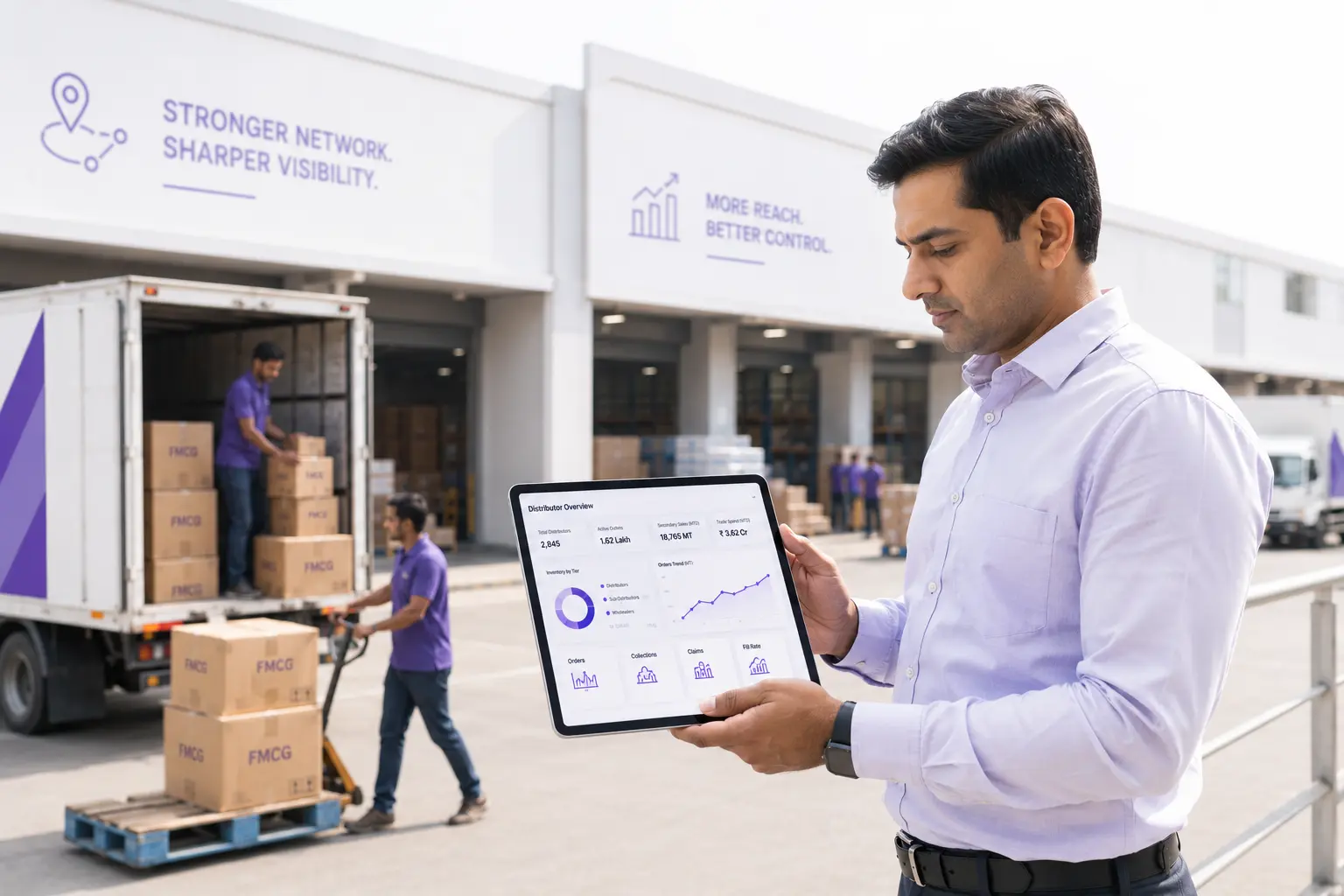
For a growing FMCG brand, distribution is where ambition meets the market. As a brand expands into new states, appoints more distributors, and reaches deeper into rural and smaller-town India, its network becomes one of its most valuable assets. It also becomes one of its richest sources of information because every new distributor, sub-distributor, and outlet adds to the picture of how products move from the brand to the shelf.
The brands that scale well treat that picture as an asset in its own right. A clear, current view of distributor stock, secondary sales, trade spend, and collections is what allows a company to grow with the same command it had when the network was smaller.
This article looks at what changes as a distribution network expands, and where leading FMCG brands focus to keep distributor visibility sharp at scale.
As a distribution network grows, a clear view of it becomes one of the most valuable assets a brand owns.
What growth adds to a distribution network
Growth extends a brand’s reach, and it deepens the structure that carries it. India’s general trade runs through a multi-layer system: brand to super stockist, to distributor, to retailer, with a field team serving each beat of outlets.
More than 13 million kirana stores account for over 90% of FMCG sales, according to Business Standard, and they are reached through this layered network. As a brand expands, it adds distributors, often sub-distributors and wholesalers, and new geographies, each one extending how far the brand can reach.
Every new layer carries more of the brand to market, and it adds to the flow of information a brand keeps in view: more orders, more schemes, more stock positions, and more receivables.
FMCG is India’s fourth-largest sector, generating around US$289 billion in revenue in 2025, according to the India Brand Equity Foundation, with rural markets contributing a significant and rising share of sales. A network built for reach naturally becomes a network rich in data.
Why visibility becomes more valuable as brands grow
Every new distributor, market, warehouse, and retail outlet adds another layer of operational complexity. As your network expands, you need faster access to accurate information to keep inventory moving, replenish stock on time, monitor distributor performance, and control trade spend. Without real-time visibility, decisions become slower, forecasting becomes less reliable, and operational issues take longer to identify.
To maintain control at scale, you need visibility across two critical parts of your distribution network.
- 1. Distributor operations: A distribution management system gives you a real-time view of inventory, orders, billing, collections, trade spend, and receivables across distributors, sub-distributors, and wholesalers.
- 2. Secondary sales: A sales force automation (SFA) platform captures what your field teams see at the retail outlet, including order capture, product availability, merchandising, and sell-out activity.
When these systems work together, you gain an end-to-end view of your distribution network, from products leaving your warehouse to products reaching retail shelves. That visibility helps you respond faster, replenish inventory more accurately, and make commercial decisions using live data instead of historical reports.
Where leading FMCG brands focus on strengthening visibility
As your distribution network grows, these capabilities have the biggest impact on operational control.
| Focus Area | What Strong Visibility Looks Like |
|---|---|
| Real-time inventory visibility | Monitor distributor, sub-distributor, depot, and warehouse inventory as it changes, so replenishment decisions are based on live stock levels. |
| Secondary sales visibility | Track sell-out alongside sell-in to understand actual market demand instead of relying only on primary sales data. |
| Trade spend management | Capture schemes, claims, incentives, and payouts digitally, giving finance and sales teams a reconciled view of trade investments. |
| N-tier distribution management | Connect distributors, sub-distributors, wholesalers, and retailers on a single platform to monitor inventory and transactions across every tier. |
| Connected commercial systems | Integrate SFA, DMS, and ERP so inventory, orders, pricing, and financial data stay synchronized across the business. |
| Analytics and AI | Use real-time reporting, forecasting, and performance insights to improve replenishment, identify risks earlier, and make faster commercial decisions. |
How leading brands build visibility that scales
As your distribution network grows, visibility depends on more than reporting. It requires systems that capture data from every part of your commercial operation and keep it synchronized in real time.
Leading FMCG brands build this by connecting their SFA, DMS, and ERP into one technology stack. Orders captured in the field flow into distributor operations for fulfilment, inventory updates, billing, and collections before syncing with enterprise systems. Every team works from the same data instead of reconciling information across multiple platforms.
They also invest in capabilities that keep visibility consistent as the network expands. Offline functionality allows distributors and field teams to continue operating in low-connectivity markets, while real-time synchronization ensures that inventory, trade spend, and secondary sales remain up to date across every tier.
The next stage is intelligence. By combining distributor transactions, secondary sales, and market data, modern DMS platforms help brands forecast demand, optimise replenishment, identify declining outlet performance, and make faster commercial decisions.
Platforms such as Vxceed Lighthouse bring these capabilities together on a single platform, connecting field execution, distributor operations, and enterprise systems to maintain visibility across large, multi-tier distribution networks.
A simple way to gauge your visibility as you scale
As a brand grows, a short set of questions can help gauge how well visibility is keeping pace. The strongest operations can answer yes to each:
- Can we see distributor and sub-distributor stock in real time, across every market?
- Do we see sell-out at the retailer, alongside sell-in to the distributor?
- Is trade spend captured and reconciled automatically across tiers?
- Are all tiers, including sub-distributors and wholesalers, on one connected platform?
- Does distributor data flow into analytics that inform the next decision?
Each yes is a sign that visibility is scaling with the network. Each one also points to where it can be strengthened further.
The bottom line
As your distribution network grows, maintaining visibility becomes just as important as expanding reach. The ability to monitor inventory, track secondary sales, manage trade spend, and connect every distributor on a single platform helps you make faster decisions, respond to market changes, and scale operations with confidence.
A modern distribution management system gives you that visibility by connecting your field teams, distributors, and enterprise systems into one real-time view of your commercial operations.
Want to see what that looks like in practice? Book a walkthrough with a Vxceed strategist to see how leading FMCG brands use Lighthouse to build connected, scalable distribution networks.
Distributor visibility is a clear, current view of how products move through a brand’s distribution network: distributor stock, order fulfillment, secondary sales at the retailer, trade spend, and collections across every tier.
As a network expands across more distributors, tiers, and markets, more information flows through it. A structured, real-time view lets a growing brand operate with the same command it had at a smaller scale. In India, more than 13 million outlets drive over 90% of FMCG sales through a multi-tier network, according to Business Standard, which makes a connected view especially valuable at scale.
Real-time distributor and sub-distributor stock, secondary sales visibility at the retailer, automatic trade spend reconciliation, full N-tier connectivity, one connected view across field and enterprise systems, and analytics that turn data into decisions.
A distribution management system gives visibility into distributor operations, including stock, fulfillment, and receivables. A sales force automation system captures secondary sales and execution at the outlet. Together, they provide a continuous view from primary dispatch to sell-out.
By bringing main distributors, sub-distributors, and wholesalers onto one connected platform, capturing data in real time and offline where needed, and integrating with the ERP, so every tier shares one current source of truth.