What Great Outlet Visibility Looks Like for Modern FMCG Sales Teams
Outlet visibility is the defining advantage of a modern FMCG sales operation. Here is what great visibility looks like, and how leading teams build it.

A modern FMCG sales operation generates an enormous amount of
activity every day. Thousands of outlet visits, orders, and
promotions move through the field across a vast distribution
network. The opportunity now is to turn all of that activity into
a clear, outlet-level view of the market, so the team can act on
what is happening at the shelf while it still matters.
In FMCG, that clarity has become the defining advantage of a
modern sales operation. It is no longer about knowing whether a
representative showed up, but rather to see the market clearly
enough to shape it. In this blog, we will set out what great
outlet visibility looks like, the dimensions that make it up, and
how leading FMCG teams build it.
What outlet visibility really means
Before that, here’s what visibility is not! It’s not a dashboard. It is the ability to see what is happening at the shelf clearly enough to act before the month is decided.
Outlet visibility is a clear, current, outlet-level view of how your commercial plan is being executed in the market. It is the ability to answer simple questions with confidence: which outlets were served this week, what they ordered, what is on their shelves, whether the promotion was applied, and which accounts are falling behind. For a sales leader, it is the difference between managing the market and managing a report about the market.
The term is often used too narrowly. Knowing a representative’s location is useful, but it is the thinnest possible definition of visibility. Great visibility is not about watching people. It is about understanding the market, outlet by outlet, in close to real time, and increasingly about anticipating what will happen next. It spans coverage, orders, stock, execution, trade assets, and money, extending from what has already happened to what is about to happen.
Why outlet visibility matters more than ever
The value of visibility scales with the size and fragmentation of the network, and few networks are larger or more fragmented than the Indian general trade. More than 13 million kirana stores account for over 90% of FMCG sales, according to Business Standard, and are served through several distributor tiers and field teams that visit each outlet. The bigger the network grows, the harder it is to see, and the more a clear view is worth.
The reason is that demand is won or lost at the shelf. Even with strong demand and an accurate forecast, sales slip away when execution does. Industry research has measured retail out-of-stock rates at around 8% for decades, and NielsenIQ reports that 70% of shoppers switch to a different brand when their usual choice is out of stock. Visibility is how you protect the demand you have already created by catching the gap while there is still time to close it.
The stakes are also growing. FMCG is India’s fourth-largest sector, generating around US$289 billion in revenue in 2025 and projected to continue growing through 2030, according to the India Brand Equity Foundation, with rural markets now contributing more than a third of sales. As growth shifts toward smaller towns and harder-to-reach beats, visibility into those outlets becomes more valuable, not less.
What great outlet visibility looks like
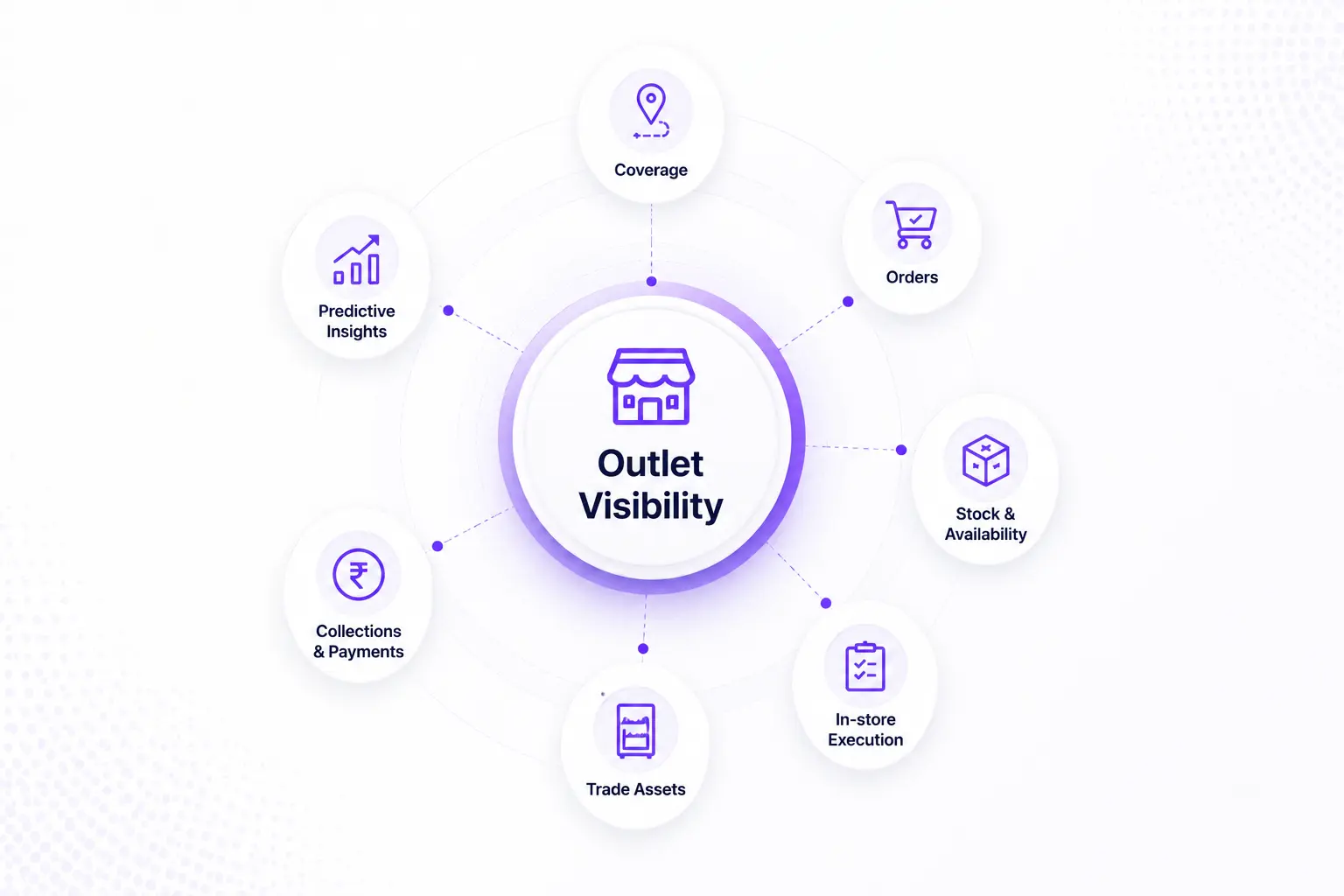
Great visibility is layered. A modern FMCG sales operation can see the market across the following dimensions and bring them together in a single view, rather than scattering them across disconnected tools.
Coverage you can trust
Not just whether a representative visited, but whether the right outlets were visited, in the right sequence, at the planned frequency. Geo-verified visits and beat adherence turn coverage from an assumption into a fact.
Orders and productivity, outlet by outlet
What each outlet ordered, how often, and how that compares to its potential. Visibility here surfaces productive and unproductive calls, drop sizes, and the lines that should be selling but are not.
Stock and on-shelf availability
What is actually on the shelf, where stockouts are forming, and how distributor inventory is moving. This is the dimension most directly tied to lost sales, and the one manual systems miss most often.
In-store execution
Whether trade schemes were applied, whether merchandising and planogram standards were met, and what competitors were doing were captured through structured surveys rather than anecdotes.
Trade assets in the market
Where branded coolers and freezers are placed, whether they are working, and whether they hold the right stock. Assets are a significant investment, and visibility protects their return.
The money at the outlet
Credit exposure, receivables, and collections at the account level, so the commercial picture includes cash, not just volume.
Foresight, not just hindsight
The most advanced dimension: seeing which outlets are likely to miss execution before it shows up in sales, so the team can act in advance rather than explain after the fact.
The dimensions at a glance
| Dimension | The question of great visibility answers |
|---|---|
| Coverage | Were the right outlets served, in the right order, at the right frequency? |
| Orders and productivity | What is each outlet buying, and what should it be? |
| Stock and availability | What is on the shelf, and where are stockouts forming? |
| In-store execution | Were schemes, merchandising, and standards actually delivered? |
| Trade assets | Are coolers and freezers placed, working, and correctly stocked? |
| Money at the outlet | What is the credit, receivables, and collection position? |
| Foresight | Which outlets will miss, and what should we do before they do? |
The visibility maturity arc: from reactive to predictive
Not all visibility is equal, and most sales operations sit somewhere on a path from looking backward to looking ahead. Understanding where you are on that path is the first step to moving along it.
| Stage | What you can see | What you can do |
|---|---|---|
| Reactive | Last month’s results, after the fact | Explain the past and react late |
| Real-time | Live, outlet-level activity through the day | Act within the day and fix issues as they form |
| Predictive | Which outlets will miss, days ahead | Prevent the miss before it reaches sales |
Most teams have some real-time visibility. The frontier, and the real differentiator for a modern sales operation, is the move from real-time to predictive: from seeing what is happening to anticipating what will happen and acting first.
How leading FMCG teams build outlet visibility
Great visibility is not the product of a single feature. It is the result of a few deliberate choices about how the sales operation is built.
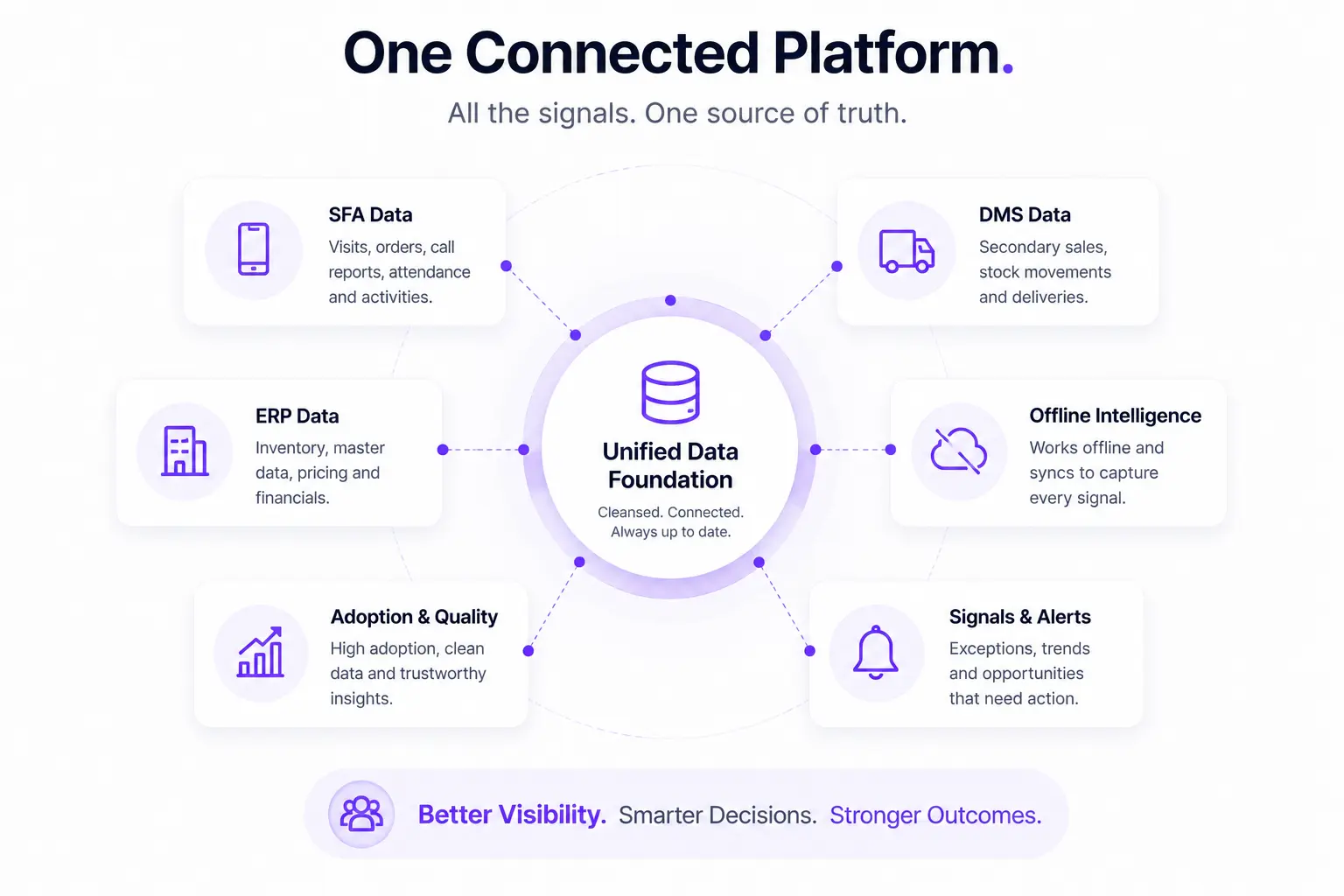
- One connected platform. Visibility breaks down when coverage, orders, stock, and money live in separate systems. Leading teams connect field sales to the distributor management system and the ERP, so the picture is whole rather than stitched together.
- Offline-first capture. Visibility cannot stop where the mobile signal does. The field tools must work offline and sync automatically, so coverage of rural and smaller town beats is real, not approximate.
- Adoption by design. Visibility is only as good as the data the field captures. A simple experience, supported by clear targets and recognition, is what turns daily use into reliable data.
- A predictive layer. The best operations add foresight to real-time data, so the team acts before the gap appears rather than after.
Lighthouse SFA by Vxceed, connects field execution, distributor operations, and trade assets in a single view, and Lighthouse Signals adds a predictive layer, scoring execution risk at the individual outlet level 48 to 72 hours before it appears in sales. We help global FMCG brands operating in a fragmented trade market build a visibility system that is whole, current, and forward-looking
We build the frontier of outlet visibility and foresight. Because seeing what is happening is now table stakes. Anticipating what will happen is the advantage.
What it takes to get there
- Treat visibility as a system, not a report. The goal is a connected, outlet-level view, not another dashboard added to the pile.
- Extend visibility to the hardest markets. The outlets that are hardest to see are often the ones where growth and leakage are greatest.
- Invest in field adoption. Reliable data depends on reliable use, so design the field experience for the representative, not the analyst.
- Aim beyond real-time. Build toward foresight, so the operation can prevent gaps rather than only record them.
The payoff
Great outlet visibility changes how a sales operation behaves. It turns month-end explanations into in-day decisions, protects the demand and trade spend a brand has already committed to, and gives leaders a market they can shape rather than a number they receive. As a brand grows into more outlets and markets, that advantage compounds because clarity scales with the network rather than thinning out across it.
For a deeper view of the systems that make this possible, see our guide to the best sales force automation software for FMCG brands in India, and our explainer on what sales force automation is and what it includes. To discuss how outlet-level visibility would look across your own distribution network, the Vxceed team can walk you through it.
See what outlet-level visibility would look like across your distribution network. Request a walkthrough session.
Outlet visibility is a clear, current, outlet-level view of how a brand’s commercial plan is being executed in the market, covering coverage, orders, stock and on-shelf availability, in-store execution, trade assets, and the credit and collection position at each account.
Because demand is won or lost at the shelf, with more than 13 million outlets driving over 90% of FMCG sales in India, a clear outlet-level view is how teams catch stockouts, unexecuted promotions, and coverage gaps while there is still time to act.
Trustworthy coverage data, order and productivity details by outlet, stock, on-shelf availability, in-store execution, trade-asset status, and the financial position at each account. The most advanced operations add a predictive layer that flags outlets at risk.
Rep tracking shows where a person is. Outlet visibility shows what is happening in the market: what each outlet ordered, what is on the shelf, whether execution was delivered, and what is likely to happen next. Location is a small part of a much larger picture.
By connecting field sales, distributor operations, and the ERP into one platform, capturing data offline so coverage extends to rural beats, and designing for field adoption. Hence, the data is reliable, and adding a predictive layer that anticipates execution gaps before they affect sales is warranted.