What Is Sales Force Automation for FMCG Companies?
A clear explainer for commercial leaders on what SFA is, what it includes, and why it underpins execution in consumer goods.
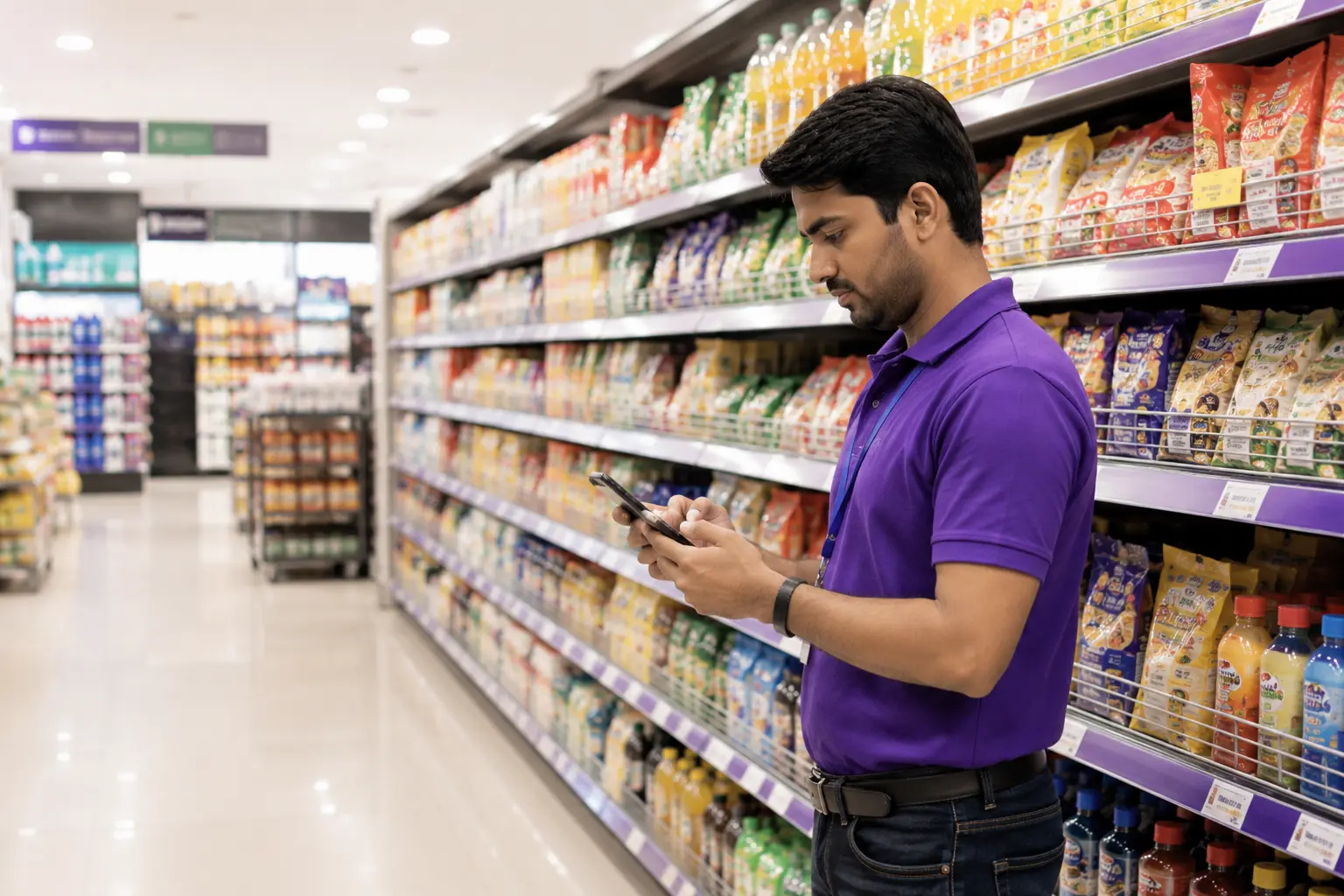
Every consumer goods (CPG) company runs on a plan. The forecast is
set, the trade promotion is funded, and the trucks leave the depot
on schedule. Yet quarter after quarter, the numbers land softer
than the plan promised, and no one can say precisely where it
slipped. The answer is usually the same: somewhere between the
warehouse and the shelf, execution came quietly apart. A missed
outlet. An empty shelf facing. A promotion that never reached the
retailer.
In India, where one brand sells through hundreds of thousands of
small stores, that gap between plan and shelf is the difference
between a strong year and a flat one. Closing it is the job of a
Sales Force Automation (SFA) platform. In this blog, we will talk
about what SFA actually is, what it does, and why it is
foundational for FMCG companies that sell at scale.
What Sales Force Automation means
Sales Force Automation (SFA) is software that digitizes and structures the work of a field sales team: planning visits, capturing orders, applying trade schemes, recording stock and shelf conditions, and feeding that activity back into the business in real time. In fast-moving consumer goods, where a single brand may sell through hundreds of thousands of small outlets, SFA is the system that turns a sales plan into consistent execution at the point of purchase.
For a consumer goods leader, it is easy to file SFA under field productivity tools. It is more accurate to treat it as the intelligent execution layer for route-to-market execution.
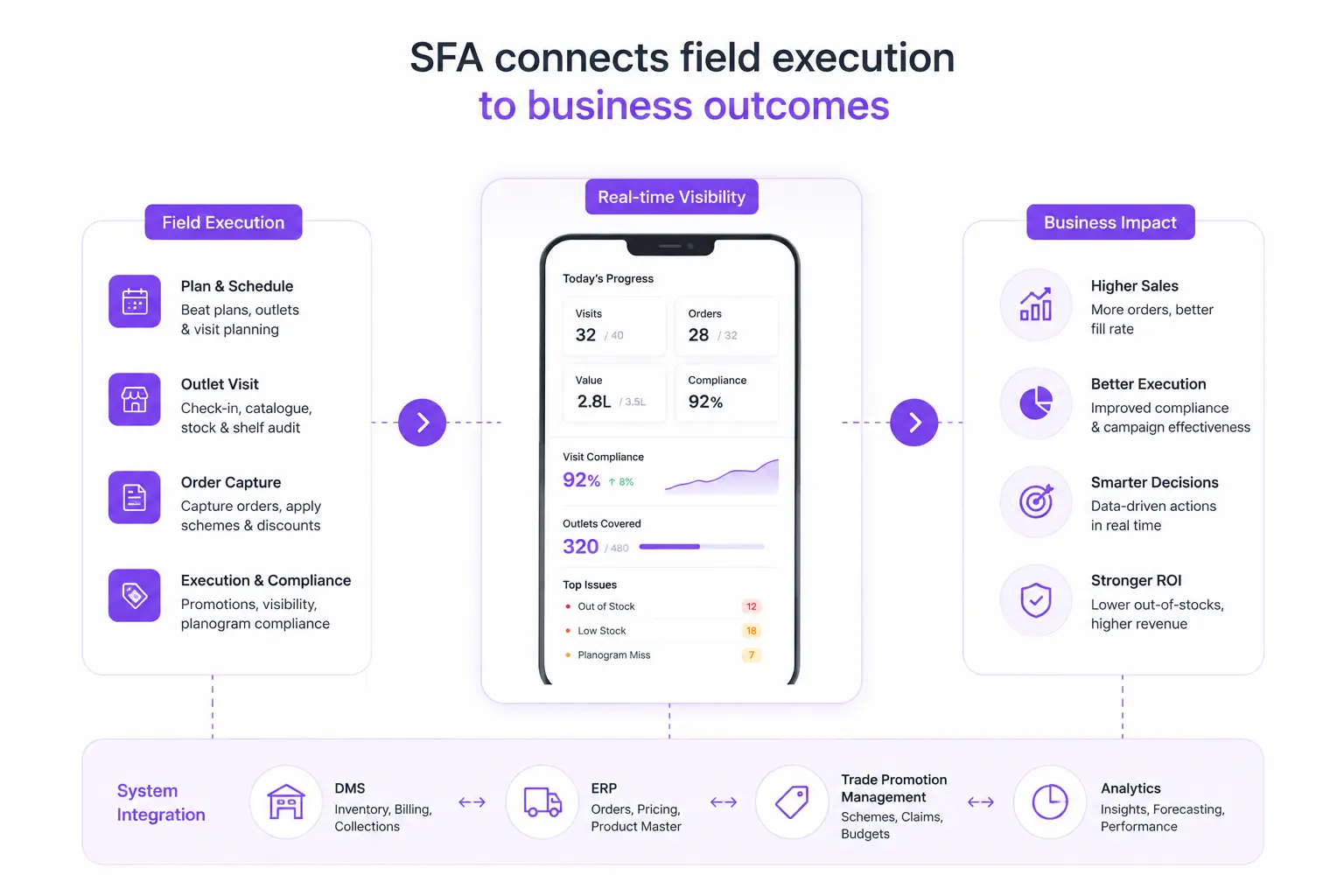
SFA is also frequently confused with customer relationship management (CRM). The two are related but solve different problems. CRM was built for relationship-led, lower frequency selling, typically business-to-business pipelines organized around named accounts and long deal cycles.
SFA in FMCG is built for high-frequency execution: a representative visiting dozens of outlets a day, taking repeat orders, and running promotions across a fixed territory. The unit of work is the outlet visit, not the deal.
Why Sales Force Automation matters in FMCG
FMCG is defined by reach. In India, more than 13 million kirana stores account for over 90% of the sector’s sales, according to Business Standard, and they are served through a layered network of super stockists, distributors, and the field representatives who visit each outlet.
FMCG is also the country’s fourth largest sector, generating around US$289 billion in revenue in 2025 and projected to keep growing through 2030, according to the India Brand Equity Foundation. Managing execution across a network of that size and fragmentation is the central operational challenge of the business.
The cost of getting it wrong is rarely visible on a dashboard until it is too late. Even with an accurate forecast and strong demand, sales are lost at the shelf. Industry studies have measured retail out-of-stock rates at around 8% for decades, and NielsenIQ research shows that 70% of shoppers will switch to a different brand when their usual choice is missing. A missed visit, an unrecorded stock out, or a promotion that never reached the retailer does not announce itself. It surfaces later as softer numbers with no obvious cause. SFA exists to make that execution visible and manageable, outlet by outlet.
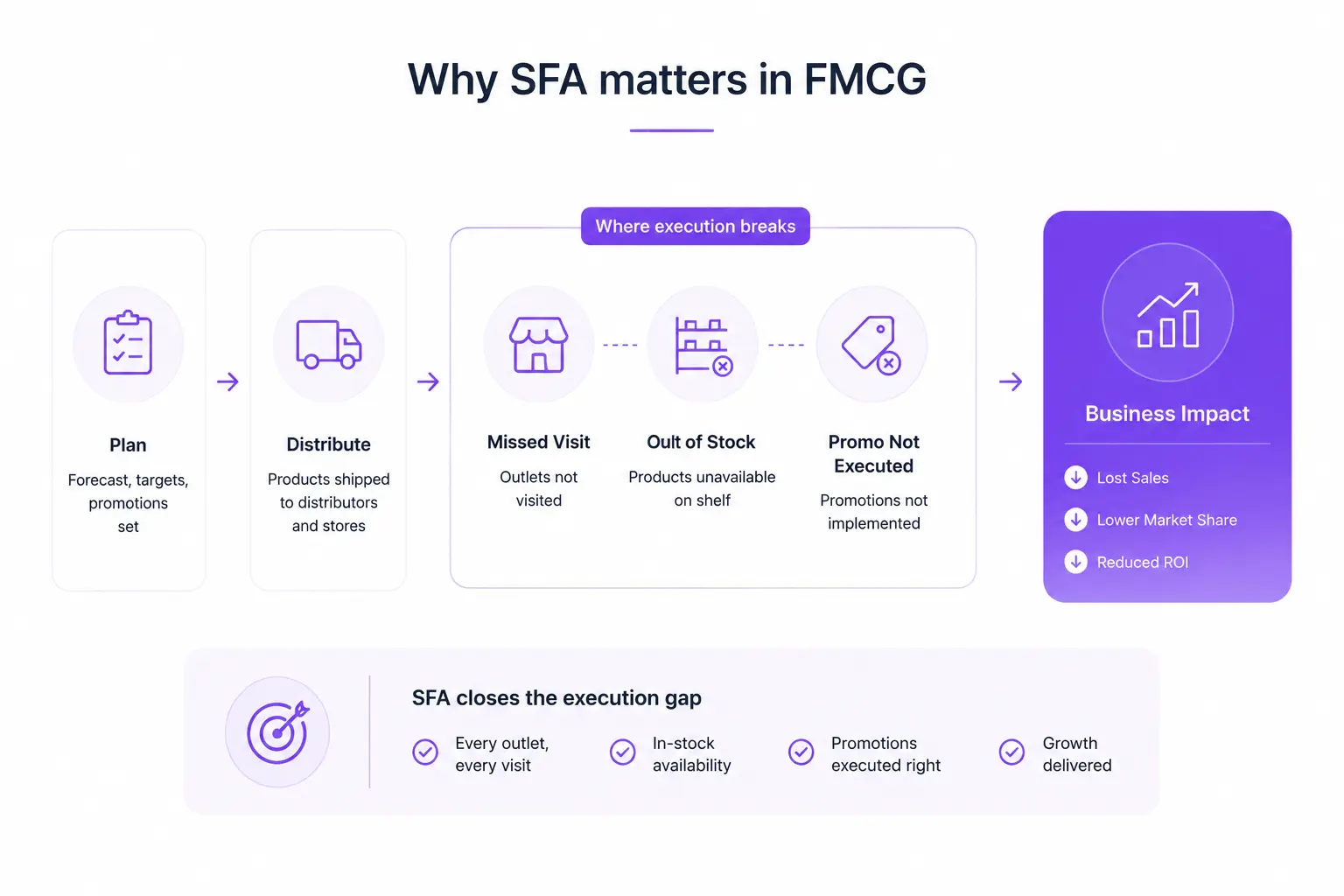
There is a strategic dimension to this as well. The investments that sit on top of distribution, trade promotions, new product launches, and in-store visibility all depend on execution to pay back. A promotion funded centrally but not run at the outlet is spent without return. Without a system that records what actually reached each store, leaders are left to infer execution from sales figures, which is both slow and unreliable. SFA provides that visibility directly, which is one reason it has moved from a field convenience to a board-level concern in consumer goods.
What Sales Force Automation includes
Modern SFA is not a single feature but a connected set of capabilities. The most important capabilities are:
| Capability | What it does |
|---|---|
| Journey and beat planning | Sequences that outline each representative's visits and when, so coverage is deliberate rather than ad hoc. |
| Digital order capture | Records orders accurately at the outlet, often offline, removing paper and manual entry errors.quantifies improvement and accelerates internal buy-in. |
| Visit verification | Uses geo location to confirm the representative is at the outlet before an order is placed. |
| In-store execution | Applies schemes, captures shelf and competitor surveys, and checks merchandising, planogram compliance, and branded assets. |
| Real-time visibility | Gives managers a live view of coverage, sales, and execution by route, product, and representative. |
| System integration | Connects field activity to the distributor management system and the ERP, so orders, pricing, and stock stay in sync. |
| Predictive intelligence | Increasingly, forecasts indicate which outlets are likely to miss execution and prompt action before sales are lost. |
How SFA relates to DMS and the commercial stack
SFA is one layer of a larger commercial system, and it is most effective when it is not isolated. SFA manages the field and the outlet. A distributor management system (DMS) manages the distributor’s operations: inventory, billing, claims, collections, and primary procurement. The two are complementary. SFA captures demand at the outlet; the DMS turns that demand into fulfilled, billed, and reconciled supply. When they are connected, and connected in turn to the ERP, a brand can trace a clean line from a representative’s order to distributor’s stock to the cash collected. We examine that relationship more closely in our companion article on SFA and DMS.
How leading FMCG companies use SFA today
The companies that get the most from SFA treat it as part of a commercial execution platform rather than a standalone app. In practice, that means a few things. The system is offline first, so it holds up across rural and smaller town markets where connectivity is unreliable. It is built for adoption, because an SFA tool that representatives avoid produces no data and no return. And it is integrated end-to-end, so field activity, distributor operations, and enterprise systems share a single version of the truth.
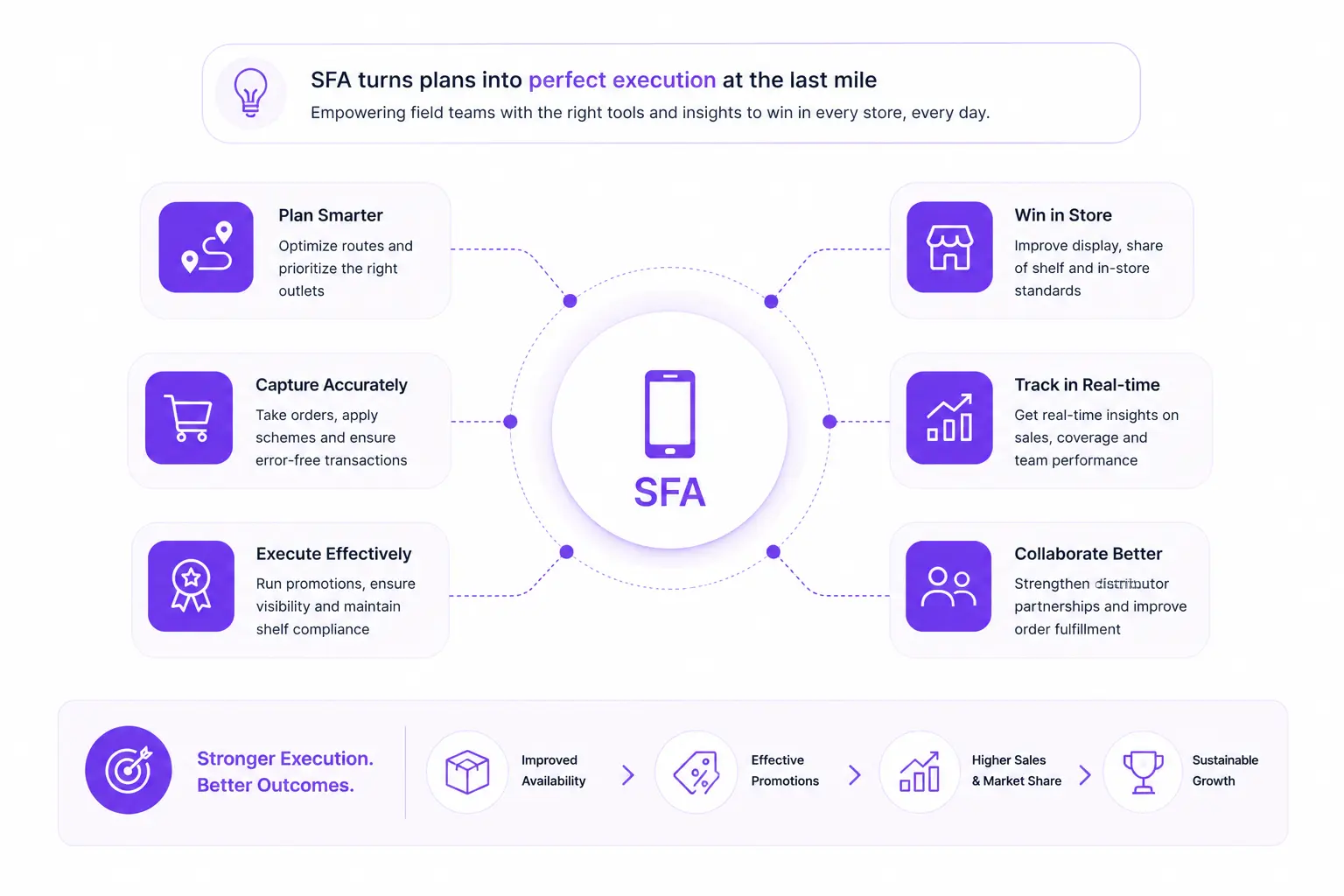
The more significant shift is from description to prediction. Conventional SFA reports what already happened: last week’s coverage, yesterday’s fill rate. By the time those numbers surface, the chance to act has passed. Newer platforms add a predictive layer that forecasts which outlets will miss execution before the miss reaches sales. Vxceed’s Lighthouse platform, for example, includes a predictive capability called Signals that scores execution risk at the individual outlet level and prompts the field team with a prioritized action before the gap appears on the shelf. For a commercial leader, that is the difference between reviewing failure and preventing it.
What to consider before adopting SFA
SFA is a commercial decision as much as a technology one. A few considerations matter more than feature counts.
- Field adoption. A simple interface and built-in motivation determine whether the system is actually used.
- Offline reliability. The platform must work where the network does not, then sync cleanly when it returns.
- Integration. Value compounds when SFA is connected to the DMS and the ERP, not run in isolation.
- Data quality. The output is only as good as what the field captures, so design for accuracy at the source.
- Scale and security. The platform should hold up across markets and meet enterprise security standards.
- Change management. Process and incentives need to move alongside the software, or the data will not follow.
The bottom line
Sales Force Automation is not a peripheral tool for FMCG companies. It is the layer that connects commercial strategy to what actually happens at the shelf, across a distribution network too large and too fragmented to manage by hand. It is less about automating things and more about giving decision makers a reliable, real-time account of the execution, and increasingly, the foresight to act before sales are lost. To discuss how an integrated approach would map to your distribution network, the Vxceed team can walk you through it. Book a call with us.
CRM is built for relationship-led, lower-frequency selling, usually in B2B pipelines with named accounts. SFA in FMCG is built for high-frequency field execution across many small outlets, where the unit of work is the outlet visit rather than the deal.
SFA manages the field sales team and what happens at the outlet. A DMS manages the distributor’s operations, including inventory, billing, claims, and collections. They work best connected, with SFA capturing demand and the DMS converting it into fulfilled, billed supply.
Because they sell through very large, fragmented networks. In India, over 13 million outlets drive more than 90% of FMCG sales. Managing coverage, orders, and execution at that scale by hand leads to blind spots and lost sales that SFA is designed to prevent.
An FMCG SFA platform should include beat planning, offline order capture, visit verification, in-store execution (schemes, surveys, merchandising), real-time visibility, and integration with the DMS and ERP. Leading platforms add predictive intelligence to flag execution risks before they affect sales.