AI for FMCG Sales Forecasting: Practical Use Cases That Deliver ROI
A practical, evidence-based guide for commercial leaders on where AI forecasting creates measurable value across the FMCG business.
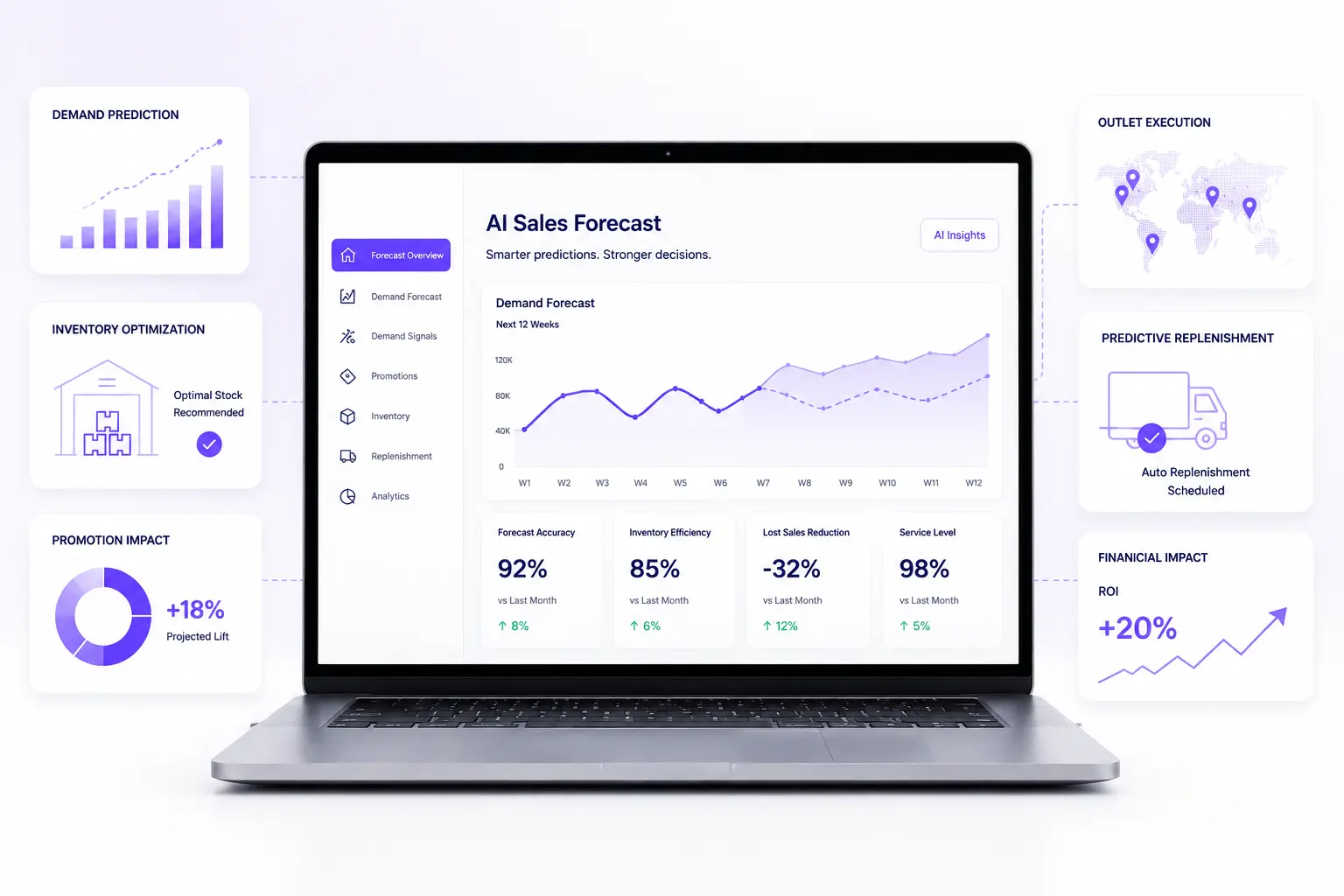
Sales forecasting has always sat at the center of a well-run FMCG business. It shapes how much to produce, where to place stock, and how to plan promotions across a network of millions of outlets.
AI has made that forecast markedly sharper, and the value that follows is now well documented. For a commercial leader, the question has moved from whether AI belongs in forecasting to where it delivers the most return.
This guide sets out the practical use cases where AI forecasting creates measurable value for FMCG brands, the returns each one can deliver, and what it takes to capture them.
AI gives forecasting a continuous, learning view of demand, and the returns it delivers are now measurable across the business.
Why AI is reshaping sales forecasting in FMCG
FMCG is a business of demand at scale. In India, more than 13 million kirana stores account for over 90% of sector sales, according to Business Standard, each with its own rhythm of what sells and when. Forecasting demand across a canvas that large and varied is exactly the kind of pattern-rich problem that AI handles well, learning from history, seasonality, promotions, and outside signals at once.
The value is substantial and well-evidenced. McKinsey research on AI-driven forecasting finds that it can reduce forecast errors by 20 to 50 percent and translate that into a reduction in lost sales and product unavailability of up to 65 percent.
At the sector level, McKinsey estimates that generative AI could unlock an additional US$160 billion to US$270 billion in annual profit for CPG companies globally, on top of the value from traditional AI. Adoption is already broad: in a 2024 McKinsey survey, 71 percent of CPG leaders reported using AI in at least one business function, up from 42 percent a year earlier.
FMCG demand is also unusually well suited to this approach. It is high in volume, rich in history, and shaped by patterns that repeat and evolve: seasons, festivals, price moves, promotions, and local events. These are exactly the signals AI reads well, and it reads them at a granularity a manual process cannot reach, down to the SKU, the outlet, and the day.
For FMCG, this accuracy compounds. A sharper forecast supports better production, cleaner inventory, and stronger promotions, all the way down to the individual outlet.
For FMCG, this accuracy compounds. A sharper forecast supports better production, cleaner inventory, and stronger promotions, all the way down to the individual outlet, and each of those gains reinforces the next.
The use cases that deliver ROI
AI forecasting creates value across several practical use cases. Each stands on its own, and together they reinforce one another.
1. More accurate demand forecasting
AI models learn from historical sales, seasonality, promotions, and external signals to predict demand at the level of the SKU, the outlet, and the day. McKinsey research on AI-driven forecasting reports error reductions of 20 to 50 percent, which flows directly into better decisions on production and stock.
Because the models learn continuously, the forecast stays current as buying patterns shift through seasons, festivals, and price changes, which matters in a market as dynamic as Indian FMCG.
2. Fewer stockouts and leaner inventory
When the forecast is sharper, availability improves, and inventory works harder. McKinsey finds that AI-driven forecasting can reduce lost sales and product unavailability by up to 65 percent, while warehousing costs fall by 5 to 10 percent.
For a brand, that means more sales captured on the shelf and less cash tied up in stock. The gain shows up twice: revenue that would have been lost to an empty shelf is retained, and working capital that would have been held as safety stock is freed for other uses.
3. Smarter trade promotion forecasting
Trade promotions are a major investment, accounting for as much as 20 percent of a food and beverage company’s revenue, according to McKinsey. AI forecasting predicts promotional lift with greater precision and separates genuine demand from cannibalization, so brands plan promotions and position stock with more confidence.
With clearer promotion forecasts, brands set the right volumes and channel mix in advance, so a scheme lands with stock in place and spend directed where it builds the brand.
4. Predictive replenishment
AI turns a sharper demand signal into action. Replenishment plans update continuously as new data arrives, so distributors hold the right SKUs in the right quantities.
The result is steadier availability and fewer emergency interventions across the network. For distributors, this steadier rhythm means better availability of fast movers and less capital held in slow ones.
5. Predictive execution at the outlet
Forecasting extends all the way to execution. AI can estimate which outlets are likely to miss a promotion, run low on a fast mover, or drift from plan, and prompt the field team to act early.
This brings the accuracy of forecasting to the point of sale, where consumer goods are won. This is the point where forecasting meets the field: a prediction becomes a prioritized visit, a specific action, and a protected sale.
6. Faster, data-driven planning
AI also lifts the planning function. By automating much of the analysis, it frees planners to focus on judgment and strategy. McKinsey associates AI-driven forecasting with administration cost improvements of 25 to 40 percent, alongside faster and better-aligned planning cycles.
Planning that once took weeks compresses into a continuously updated view, so the commercial and supply teams work from one current picture of demand.
How the ROI adds up
Read together, the use cases map to a clear set of value levers. The figures below come from McKinsey research on AI-driven forecasting and on AI in CPG, and give a grounded sense of the returns available.
| Value Lever | Reported Impact | Source |
|---|---|---|
| Forecast accuracy | 20 to 50 percent reduction in forecast errors | McKinsey |
| Availability | Up to 65 percent reduction in lost sales and product unavailability | McKinsey |
| Warehousing cost | 5 to 10 percent reduction in warehousing costs | McKinsey |
| Planning and administration | 25 to 40 percent improvement in administration costs | McKinsey |
| Sector-wide opportunity | US$160 to US$270 billion in additional annual CPG profit from generative AI | McKinsey |
These are published benchmarks for AI-driven forecasting, so they set a reasoned expectation of the value available. The return for any brand depends on its data, its execution, and how far the forecast reaches into the field.
Where AI forecasting fits in your commercial stack
AI forecasting delivers the most when it sits on a strong foundation of commercial data. Three layers feed it.
- 1. Sales force automation captures what happens at the outlet, from visits and orders to stock and shelf conditions.
- 2. A distribution management system captures how products move through distributors, including inventory, fulfillment, and trade spend.
- 3. The forecast draws on both, and a predictive layer turns the result into action in the field.
This connection is what carries a forecast beyond the planning room. A number on a screen becomes a replenishment plan for a distributor and a prioritized action for a field representative. For more on these foundations, see our explainers on distribution management software and predictive sales intelligence.
What it takes to capture the value
The returns are real, and capturing them comes down to a few sound choices:
- Build on connected data. AI forecasting draws its accuracy from clean, integrated data across sales, inventory, promotions, and distribution.
- Connect forecasting to execution. Value grows when the forecast reaches the field and the distributor, so it shapes action at the outlet.
- Start focused. A defined starting point, such as a category or a set of markets, builds accuracy and confidence before scaling.
- Keep a human in the loop. The strongest programs pair AI with planner judgment, so forecasts reflect both data and market knowledge.
- Measure the return. Track forecast accuracy, availability, and inventory, so the value is visible and compounds over time.
A staged path to value
Most brands capture this value in stages, building confidence at each step:
- Prove it on a focused scope. Begin with one category or a set of markets, and measure the lift in forecast accuracy against the current baseline.
- Connect it to execution. Bring the forecast into the field and the distributor, so it shapes replenishment and outlet-level action.
- Scale across the network. Extend the approach to more categories and markets as the results compound, so each stage funds the next.
A staged path keeps every step measurable and lets early returns build the case for the next. It also gives planners and field teams time to grow confident in the forecast, which is what turns a capable model into daily practice.
How leading FMCG brands put AI forecasting to work
Leading consumer goods brands already apply AI forecasting at the level of the individual outlet. Industry research reports consumer goods companies using AI to predict daily demand at individual sales points, so field and supply decisions rest on a forward view of demand.
Platforms built for FMCG bring forecasting and execution together. Vxceed’s Lighthouse platform, for example, pairs distributor and field data with a predictive layer called Signals that scores execution risk at the individual outlet level and prompts action before sales are affected. The value is in the connection: a forecast that reaches the field as a specific, prioritized action.
The commercial effect is direct. When the forecast reaches the field as a specific action, promotions are more likely to run as planned, fast movers stay in stock, and the trade spend behind them is protected. Forecasting stops being a back-office exercise and becomes part of how the brand competes at the shelf.
The bottom line
AI has made sales forecasting one of the clearest sources of return in FMCG. Across demand accuracy, availability, trade promotions, replenishment, outlet-level execution, and planning productivity, the value is measurable and well documented. The brands that capture it build a commercial engine that anticipates demand and acts on it early, outlet by outlet.
The path there is practical and staged, and it rests on evidence rather than promise. For a commercial leader, the opportunity is to decide where the first, clearest return sits, and to build from there.
As FMCG organisations generate more execution data than ever before, competitive advantage increasingly comes from acting on that data before revenue is affected, not simply reporting on what has already happened.
Book a walkthrough with a Vxceed strategist and see how AI forecasting would deliver the most return across your distribution network.
It is the use of AI and machine learning to predict demand across SKUs, outlets, and time, learning from historical sales, seasonality, promotions, and external signals. In FMCG, it supports production, inventory, promotions, and outlet-level execution.
McKinsey research on AI-driven forecasting reports forecast error reductions of 20 to 50 percent, up to 65 percent fewer lost sales, 5 to 10 percent lower warehousing costs, and a 25 to 40 percent improvement in administration costs. At the sector level, McKina sey estimates generative AI could add US$160 to US$270 billion in annual CPG profit globally.
Demand forecasting accuracy, fewer stockouts and leaner inventory, trade promotion forecasting, predictive replenishment, predictive execution at the outlet, and faster, data-driven planning.
Clean, integrated data across sales, inventory, promotions, and distribution, ideally in real time. External signals such as seasonality and market events sharpen accuracy further.
Begin with connected data, a focused starting point such as a category or set of markets, a human-in-the-loop model, and clear measures of accuracy and availability, then scale as confidence grows.