What drives forecast accuracy in FMCG?
An explainer for commercial leaders on the factors that shape forecast accuracy in FMCG and how leading brands strengthen it.
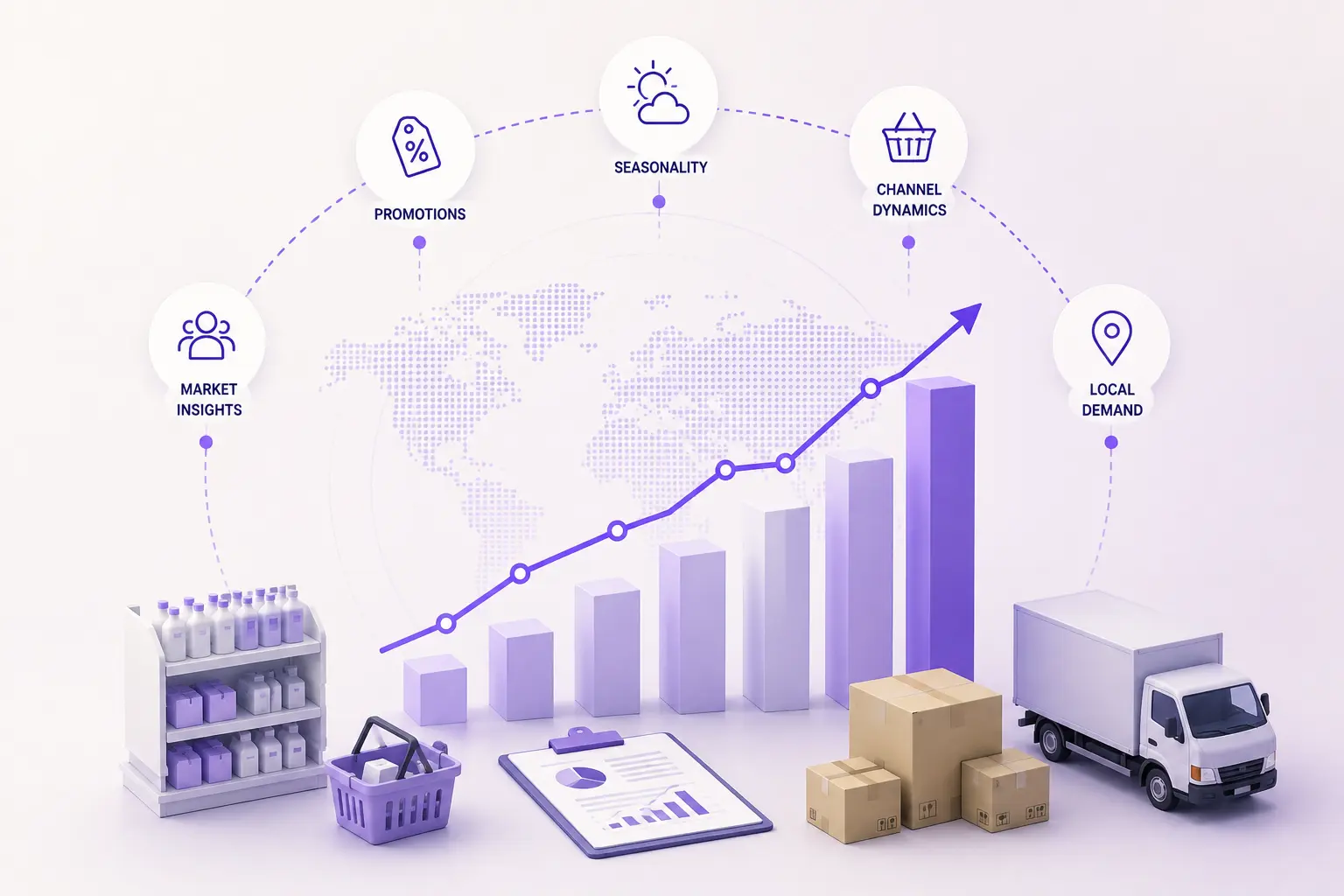
Every forecast influences hundreds of commercial decisions. It determines how much inventory you produce, where you position stock, which distributors you replenish, and whether your promotions have products on the shelf when demand peaks. When your forecasts are accurate, your supply chain stays balanced, inventory moves efficiently, and commercial teams can execute with confidence.
For FMCG brands, maintaining forecast accuracy isn't easy. Demand changes quickly, promotions create unpredictable spikes, product portfolios expand, and millions of retail outlets generate new sales signals every day.
In this guide, you'll learn what drives forecast accuracy in FMCG, why some forecasts consistently outperform others, and the operational, data, and technology capabilities leading consumer goods companies use to improve forecasting across large distribution networks.
In FMCG, a rich and fast-moving market makes an accurate forecast one of the most valuable assets a brand can build.
What does forecast accuracy mean in FMCG?
Forecast accuracy measures how closely your demand forecast matches actual customer demand. In FMCG, that forecast influences almost every operational decision, from production planning and inventory allocation to distributor replenishment and promotion planning.
Most organizations measure forecast accuracy using metrics such as Mean Absolute Percentage Error (MAPE), where a lower percentage indicates a more accurate forecast. But for commercial leaders, the number itself matters less than the business decisions it supports.
An accurate forecast helps you:
- Produce the right quantities at the right time.
- Position inventory where demand is expected.
- Replenish distributors before fast-moving SKUs go out of stock.?
- Plan promotions with greater confidence.
- Reduce excess inventory and working capital tied up in slow-moving products.
Forecast accuracy also needs to be measured at the level where decisions are made. A forecast may appear accurate at a national level while masking significant demand fluctuations across individual regions, distributors, or retail outlets. Measuring accuracy by SKU, outlet, and day provides a much clearer view of where forecasting can improve and where operational decisions need to change.
What shapes forecast accuracy in FMCG
Forecast accuracy improves when your planning process captures the variables that influence demand most. The more accurately your forecast reflects what's happening across your distribution network, the better your supply chain can respond.
The biggest drivers of forecast accuracy include:
| Factor | Why It Matters |
|---|---|
| Distribution network complexit | Demand varies across millions of retail outlets, distributor tiers, and geographic regions, each with different buying patterns. |
| Demand variability | Seasonality, festivals, weather, local events, and regional preferences all influence demand throughout the year. |
| Trade promotions | Promotions can significantly change buying behavior. Forecasts need to distinguish genuine incremental demand from stock-loading or sales shifted from other periods. |
| New product launches | New SKUs have limited historical data, making early sales signals and market feedback critical for improving forecast accuracy. |
| Channel mix | General trade, modern trade, quick commerce, eB2B, and ecommerce each have different ordering patterns, fulfillment cycles, and demand volatility. |
| Data quality and freshness | Forecasts improve when they use accurate, up-to-date sales, inventory, promotion, and distributor data instead of delayed or incomplete information. |
No single factor determines forecast accuracy on its own. The strongest forecasting processes combine reliable data, a deep understanding of demand drivers, and continuous updates as market conditions change. As your product portfolio, channels, and distribution network expand, those capabilities become increasingly important for maintaining inventory availability while controlling costs.
How leading FMCG brands strengthen forecast accuracy
Forecast accuracy doesn't improve because you choose a better forecasting model. It improves when your planning process continuously adapts to changing demand using high-quality, real-time data.
Leading FMCG brands typically focus on the following capabilities.
- Use AI to identify demand patterns. AI and machine learning read history, seasonality, and promotions together, and keep learning as new data arrives. McKinsey research on AI-driven forecasting reports error reductions of 20 to 50 percent.
- Continuously update demand signals. Live sales and stock signals let the forecast update continuously, so it reflects what is happening now.
- Build forecasts on connected data. Accuracy grows when sales, inventory, promotions, and distribution data sit together, giving the forecast a complete picture.
- Forecast where decisions are made. Strong forecasts work at the level of the SKU, the outlet, and the day, where decisions are actually made..
- Combine analytics with commercial expertise. Human judgment adds market knowledge that the data may not capture, so the forecast reflects both.
Together, these raise accuracy steadily, and the gains carry through to production, inventory, and the shelf.
The most effective programs combine these approaches. A model that learns from rich data, senses demand as it forms, and draws on the judgment of experienced planners produces a forecast that is both accurate and trusted, which is what turns a good model into daily practice.
How forecast accuracy connects to execution
A forecast only creates value when it influences operational decisions. The strongest FMCG organizations connect forecasting directly to sales and distribution execution so that demand signals lead to action across the network.
That connection improves execution in several ways:
- Supply chain teams replenish distributors before fast-moving SKUs run out of stock.
- Trade marketing teams adjust promotional plans when demand changes.
- Sales managers prioritize territories where execution risks are increasing.
- Field representatives focus on outlets where intervention is most likely to protect revenue.
Modern FMCG platforms make this possible by connecting forecasting with execution intelligence. Vxceed Lighthouse, for example, combines forecasting data with Signals, its predictive execution intelligence layer. Using data from SFA, DMS, POS, and ERP systems, Signals identifies outlet-level execution risks 48 to 72 hours in advance and recommends where field teams should act first.
When forecasting and field execution operate together, forecast accuracy becomes more than a planning metric. It helps improve product availability, protect trade promotions, reduce stock-outs, and ensure commercial decisions are based on what's most likely to happen—not simply what has already happened.
The bottom line
Forecast accuracy in FMCG is shaped by a rich set of factors, and it responds well to the right approach. By reading demand patterns with AI, sensing signals in real time, connecting data, forecasting at the right level, and pairing the model with human judgment, brands raise accuracy in a measurable way. The value follows in cleaner inventory, stronger promotions, and steadier availability across the network.
Schedule a demo with a Vxceed strategist and see how stronger forecast accuracy would work across your distribution network.
Forecast accuracy describes how closely a demand forecast matches actual sales, often measured with metrics such as mean absolute percentage error. In FMCG, it is tracked at many levels, from the national plan down to the SKU, the outlet, and the day.
The breadth of the distribution network, demand variability from seasons and events, promotions, new product launches, the channel mix, and the freshness of the data feeding the forecast. A strong forecast accounts for all of these.
By using AI and machine learning to read demand patterns, sensing signals in real time, connecting sales, inventory, and promotion data, forecasting at the SKU and outlet level, and keeping planners in the loop.
Commonly with error metrics such as mean absolute percentage error (MAPE) or weighted absolute percentage error (WAPE), where a lower error indicates a closer match between forecast and actual demand.
AI models learn from history, seasonality, promotions, and external signals at once and update continuously as new data arrives. McKinsey research on AI-driven forecasting reports error reductions of 20 to 50 percent.