What Is Predictive Sales Intelligence?
A clear explainer for commercial leaders on how predictive sales intelligence helps FMCG brands prevent execution failures before they affect revenue.
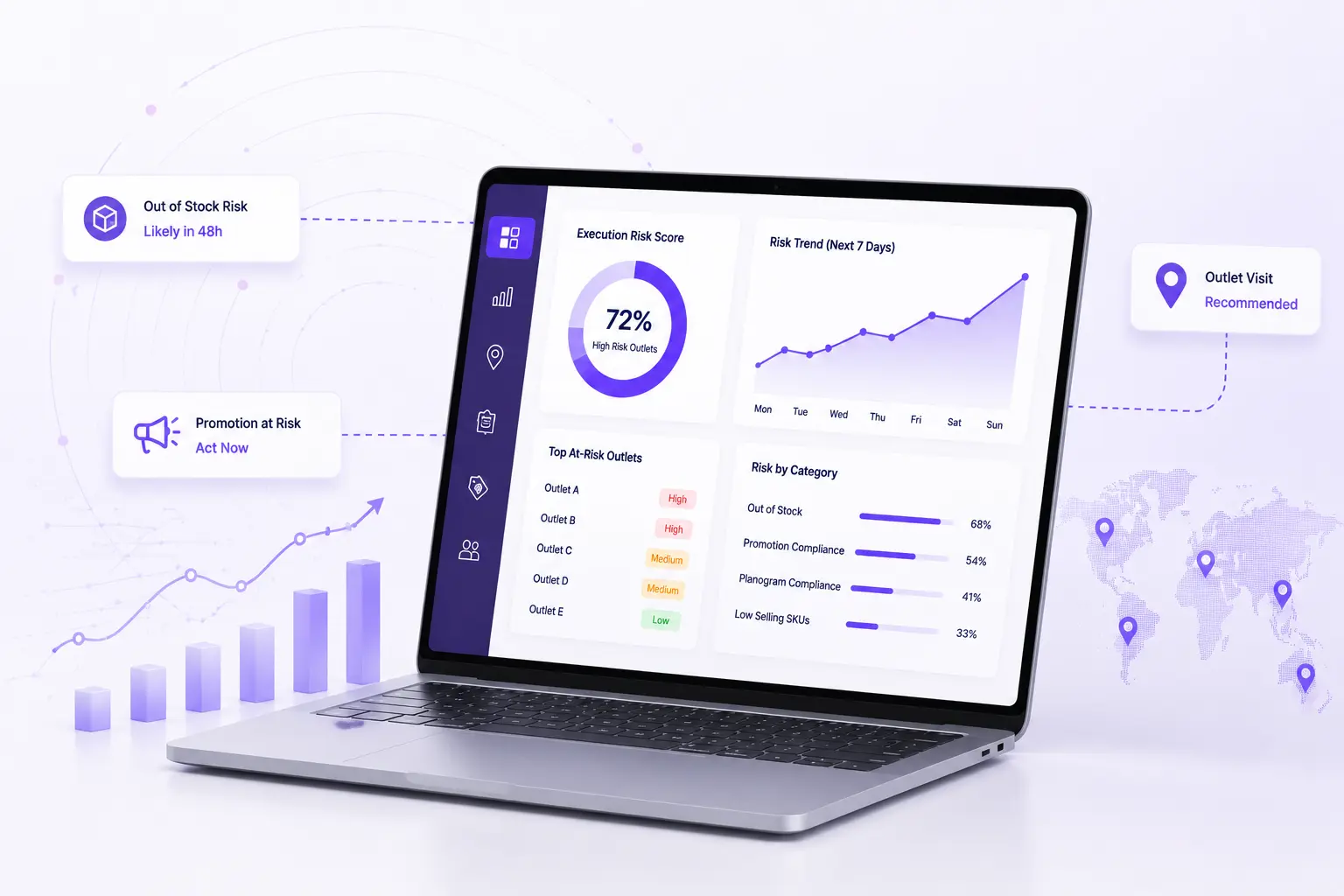
Every day, your field teams make decisions that influence sales. Which outlets need attention? Which promotions are at risk? Where should your reps spend their limited time? Most of those decisions rely on reports that describe what has already happened. By the time an out-of-stock, promotion failure, or compliance issue appears in a dashboard, the opportunity to prevent it has often passed.
Predictive sales intelligence changes that. It uses data from your sales, distribution, and retail operations to identify execution risks before they impact revenue, giving your teams time to intervene while the outcome can still be influenced.
For FMCG brands managing thousands of outlets, distributors, and active promotions, that capability changes how field execution works. Instead of reacting to problems during store visits, your teams can prioritise the outlets that need attention most, protect trade spend, and focus on the actions that will have the biggest commercial impact.
In this guide, you'll learn what predictive sales intelligence is, how it works, and how leading FMCG brands use it to make faster decisions, improve field execution, and protect revenue before execution gaps reach the shelf.
Predictive sales intelligence helps your teams identify execution risks early, prioritise the right outlets, and act before revenue is lost.
What predictive sales intelligence means
Every day, your field teams make hundreds of decisions about which outlets to visit, which promotions to prioritise, and where to spend their time. Those decisions often rely on reports that describe what has already happened. By the time an out-of-stock, promotion failure, or planogram issue appears in a dashboard, you've already lost the opportunity to prevent it.
Predictive sales intelligence helps you act earlier. It combines data from your Sales Force Automation (SFA) platform, Distribution Management System (DMS), point-of-sale systems, promotion calendars, and historical outlet performance to identify where execution risks are likely to emerge over the next 48 to 72 hours. It then recommends the actions your field teams should take before those risks affect sales.
Instead of asking "What happened?", your commercial teams can answer questions that directly influence execution:
- Which outlets are most likely to go out of stock?
- Which promotions are at risk of poor execution?
- Which stores should field reps visit first?
- What action will have the biggest commercial impact today?
This gives your sales organisation more than visibility. It gives every field representative a prioritised plan built around the outlets where intervention can protect revenue, improve execution, and maximise trade investments.
Why predictive sales intelligence matters for FMCG
Every day, your commercial teams make decisions that affect revenue: which outlets to prioritise, where to allocate trade spend, which promotions need attention, and where inventory should move next.
Predictive sales intelligence gives your teams that lead time by identifying execution risks before they become commercial losses. Instead of reacting to issues during a store visit, your teams know where intervention will have the greatest impact.
As your distribution network grows, this creates value across every commercial function.
For field sales
Field representatives start the day with a prioritised list of outlets based on execution risk. They spend more time fixing high-impact issues and less time following static beat plans or analysing reports.
For trade marketing
Promotions become easier to protect. Instead of discovering poor execution after a campaign ends, you can identify stores that are likely to miss compliance while there's still time to intervene and improve ROI.
For commercial leaders
Outlet-level intelligence makes resource allocation more precise. Territory planning, distributor management, and trade investments can all be based on predicted execution risk rather than historical reporting, helping teams focus on the opportunities that will have the biggest commercial impact.
For the business
As AI adoption accelerates across FMCG, the competitive advantage shifts from analysing what happened to acting before revenue is affected. McKinsey estimates that generative AI could unlock an additional US$160–270 billion in annual profit for consumer packaged goods companies globally, with trade promotions among the areas expected to benefit most.
Predictive sales intelligence turns that opportunity into day-to-day execution by helping your teams prevent revenue leakage before it reaches the shelf.
How predictive sales intelligence works
Predictive sales intelligence transforms everyday sales and distribution data into clear actions for your field teams. Instead of asking managers to analyse multiple reports, it continuously evaluates outlet performance, predicts where execution is most likely to break down, and recommends where your teams should intervene first.
The process typically follows four stages:
| Stage | What Happens |
|---|---|
| Collect data | The platform combines historical outlet performance, real-time POS and sell-out data, promotion calendars, distributor transactions, inventory data, and field activity into a single view. |
| Predict execution risk | AI models analyse patterns across every outlet to identify risks such as stock-outs, promotion non-compliance, declining sales velocity, or planogram drift before they affect revenue. |
| Prioritise opportunities | Every outlet is assigned a risk score based on urgency and commercial impact, helping managers and field teams focus on the stores that need attention first. |
| Recommend actions | Mobile-ready action lists tell field representatives exactly what to do during the next visit, whether that's replenishing stock, auditing displays, improving promotion compliance, or escalating an issue. |
By the time a field representative starts the day, the platform has already answered four critical questions for every outlet:
- What is likely to happen?
- Why it is likely to happen?
- When to act?
- What action to take?
How predictive sales intelligence fits with your sales and distribution systems
Predictive sales intelligence doesn't replace your existing sales and distribution systems. It builds on the data they already generate and turns it into decisions your teams can act on.
Each system contributes a different piece of the picture:
| System | What It Contributes |
|---|---|
| Sales Force Automation (SFA) | Outlet visits, order capture, product availability, merchandising, and field execution data. |
| Distribution Management System (DMS) | Distributor inventory, order fulfilment, trade spend, billing, collections, and secondary sales. |
| ERP | Product master data, pricing, financials, and enterprise planning. |
| Predictive Sales Intelligence | Analyses data from every system to identify execution risks, prioritise outlets, and recommend actions before revenue is affected. |
When these systems work together, your teams move beyond operational reporting. Instead of analysing multiple dashboards, they receive outlet-level insights that help them decide where to focus, when to intervene, and what action to take next.
How leading FMCG brands use predictive sales intelligence
Leading FMCG brands use predictive sales intelligence to improve execution before it affects sales. Rather than treating every outlet as equally important, they prioritise stores based on predicted commercial risk, allowing field teams to focus on the interventions that will have the greatest impact.
Across the organisation, predictive intelligence helps teams:
- Protect trade promotions by identifying outlets that are likely to miss execution targets before promotional windows close.
- Reduce out-of-stocks by highlighting stores where inventory risks are emerging.
- Prioritise field visits based on outlet-level risk instead of fixed visit schedules.
- Improve resource allocation by directing sales teams toward the stores that matter most.
- Respond faster because recommendations reach field representatives before the first visit of the day.
Platforms such as Vxceed Lighthouse Signals bring this capability into day-to-day field operations. Signals analyses data from your existing DMS, SFA, POS, and ERP systems to predict outlet-level execution risks 48 to 72 hours in advance. Instead of asking managers to analyse reports, it delivers prioritised, mobile-ready action lists that tell field representatives exactly where to focus and why.
The result is a field organisation that spends less time reacting to execution issues and more time preventing them, helping protect revenue, improve promotion compliance, and maximise the return on every store visit.
What to consider when adopting predictive sales intelligence
The value of predictive sales intelligence depends on more than the quality of the AI model. It depends on whether your teams can trust the predictions and act on them quickly.
As you evaluate different solutions, focus on these capabilities:
- Reliable data foundation: Predictions are only as accurate as the data behind them. Look for a platform that combines field execution, distributor operations, POS, and historical outlet performance into a single, continuously updated view.
- Integration with your existing systems: Predictive intelligence should work with your existing SFA, DMS, and ERP, not alongside them. The richer the execution data, the more accurate the predictions.
- Actionable recommendations: A risk score alone doesn't improve execution. Your field teams should receive clear, prioritised actions that tell them which outlets to visit, why they're at risk, and what intervention to make.
- Mobile-first delivery: Insights need to reach your sales representatives before the first outlet visit, not after managers have reviewed dashboards. Mobile-ready action lists help teams spend more time executing and less time analysing.
- A focused implementation: Start with a high-impact use case, such as improving promotion compliance, reducing out-of-stocks, or prioritising outlet visits. Demonstrating measurable business outcomes early makes it easier to expand predictive intelligence across the rest of your commercial operations.
The bottom line
Every execution gap has a cost. A missed promotion, an out-of-stock SKU, or a poorly prioritised field visit can reduce revenue long before it appears in a report.
Predictive sales intelligence helps you identify those risks while there's still time to influence the outcome. By combining AI with real-time sales, distribution, and outlet data, it enables your teams to focus on the stores, promotions, and actions that will have the greatest commercial impact.
As FMCG organisations generate more execution data than ever before, competitive advantage increasingly comes from acting on that data before revenue is affected, not simply reporting on what has already happened.
Want to see how predictive sales intelligence works? Book a walkthrough with a Vxceed strategist to explore how Lighthouse Signals helps commercial teams predict execution risks, prioritise field activity, and protect revenue across the distribution network.
Predictive sales intelligence is the use of data and AI to anticipate what is likely to happen in the market and to recommend action ahead of time. In FMCG, it works at the outlet level, estimating where execution, availability, and promotion performance are heading, and pointing teams to the actions that keep results on track.
It sits within the analytics spectrum. Descriptive analytics summarize what has happened, predictive analytics estimate what is likely to happen next, and prescriptive analytics recommend the action to take. Predictive sales intelligence brings the forward-looking and action-oriented parts together for the sales operation.
Historical outlet performance, real-time sell-out and POS data, promotion schedules, and distributor and field activity captured by SFA and DMS systems. The richer and more current the data, the sharper the foresight.
FMCG runs on execution across millions of outlets, so acting early protects demand and trade spend. McKinsey estimates generative AI could unlock an additional US$160 billion to US$270 billion in annual CPG profit globally, on top of traditional AI, with trade promotions among the areas that benefit most.
Sales force automation captures outlet-level execution, and a distribution management system captures distributor operations. Predictive sales intelligence draws on both, turning that data into a forward view and recommended actions delivered to the field.