Direct Distribution vs. Distributor-Led RTM: Choosing the Right Model by Category
 Team Vxceed · September 2026
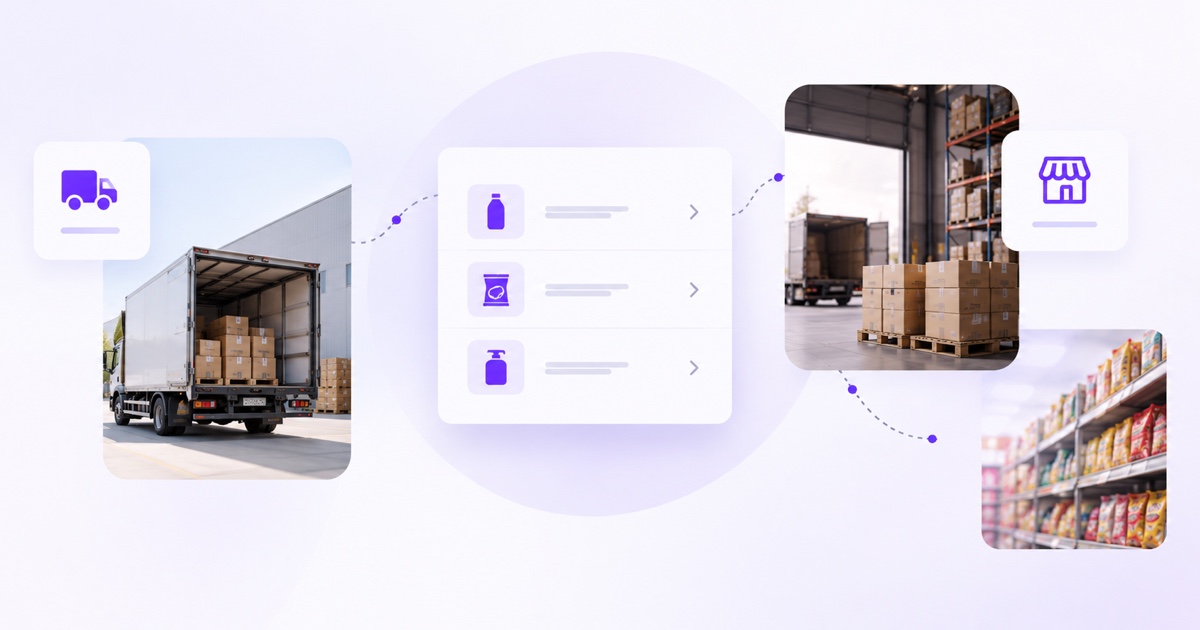
Every few years, a version of the same debate resurfaces in FMCG leadership meetings: should the company go direct and capture the distributor's margin, or stay distributor-led and keep the balance sheet lighter? The debate usually gets framed as a philosophy question, control versus asset efficiency, when it is actually an arithmetic question that changes answer by category, by geography, and sometimes by outlet cluster within the same city.
Neither model is inherently superior. Direct distribution wins when the economics support it and loses badly when they do not, and the same is true in reverse for a distributor-led model. The companies that get this right rarely pick one model for the whole business. They run both, deliberately, and know exactly where the line sits.
What direct distribution actually buys you
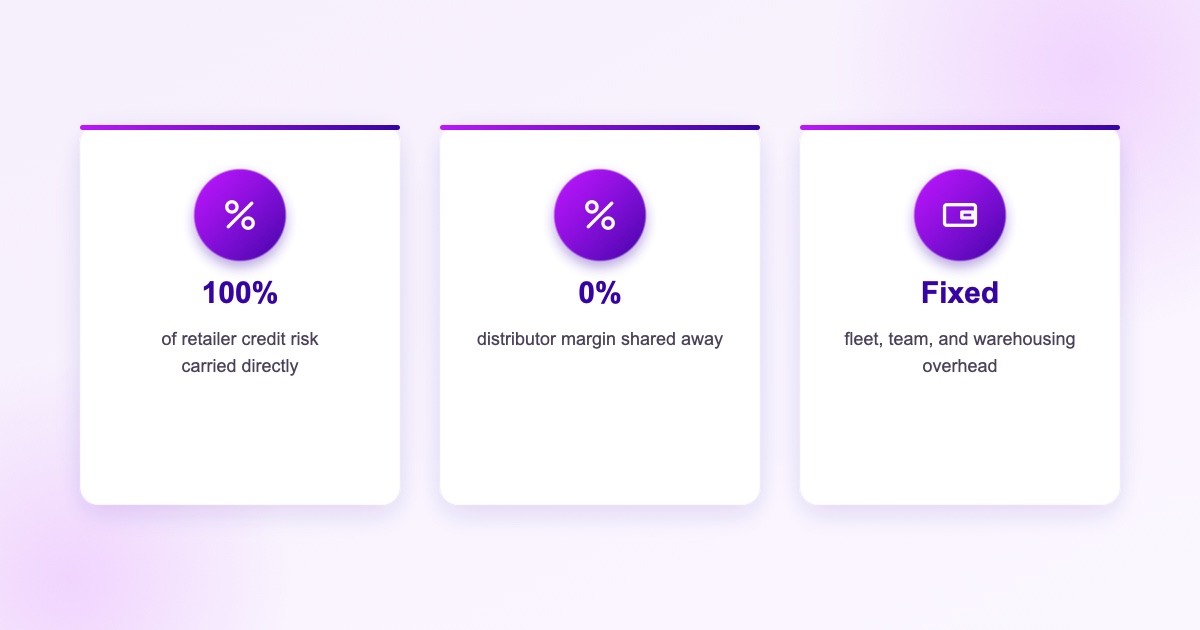
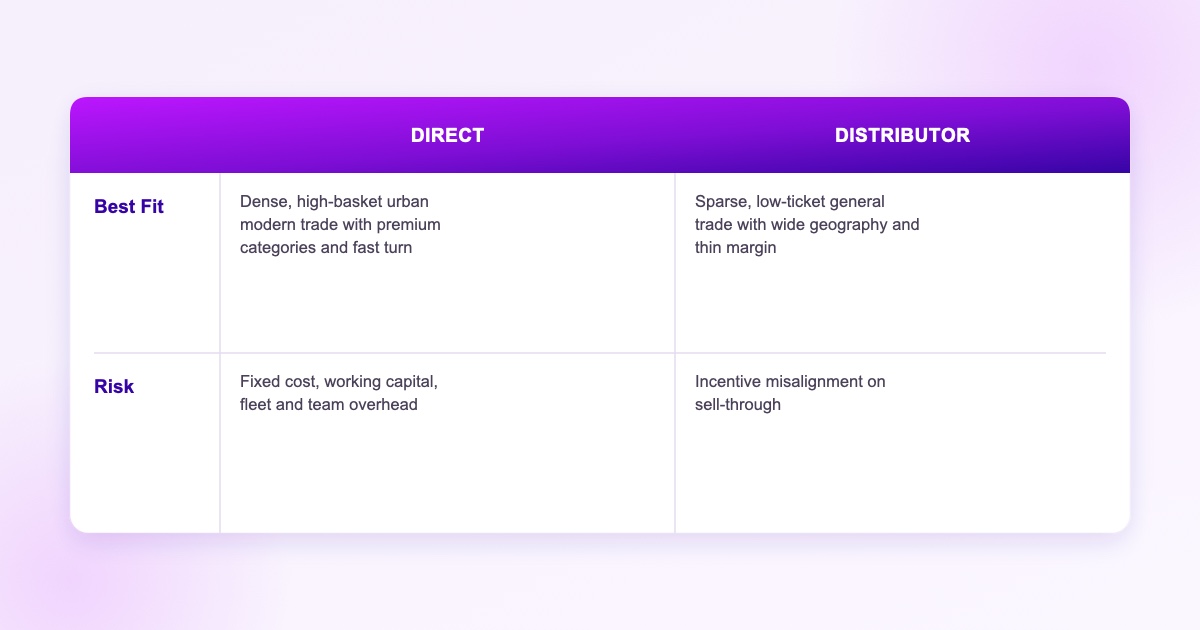
Going direct means the brand owns the sales team, the delivery vehicle, and the retailer relationship end to end. The appeal is real: no distributor margin to share, full control over which SKUs get pushed and when, and first-party data on every order instead of a distributor's summarized sell-out report. For a premium category with high basket size and a dense urban footprint, that control can be worth several points of margin.
What direct distribution does not buy you is lower cost. A brand-owned sales team, a fleet of delivery vans, and the working capital to carry credit directly with hundreds of retailers is expensive infrastructure, and it stays expensive whether the outlets it serves are dense and profitable or scattered and marginal. Direct distribution concentrates cost the same way it concentrates control.
Where a distributor-led model wins on arithmetic, not just tradition
A distributor absorbs three costs a brand would otherwise carry directly: the working capital tied up in retailer credit, the local relationship capital built over years of servicing the same streets, and the last-mile density that makes a low-ticket outlet worth visiting at all. In markets where general trade still accounts for most volume, that density advantage is close to impossible for a brand-owned team to replicate at the same cost.
The tradeoff is real too. A distributor's incentives are not automatically aligned with a brand's, particularly on sell-in versus sell-out: a distributor paid on primary billing has less reason to chase sell-through than a brand does, which is exactly why distributor-led models need service-level agreements and incentive structures that reward the outcome the brand actually cares about, not just the invoice.
The variables that actually decide the answer
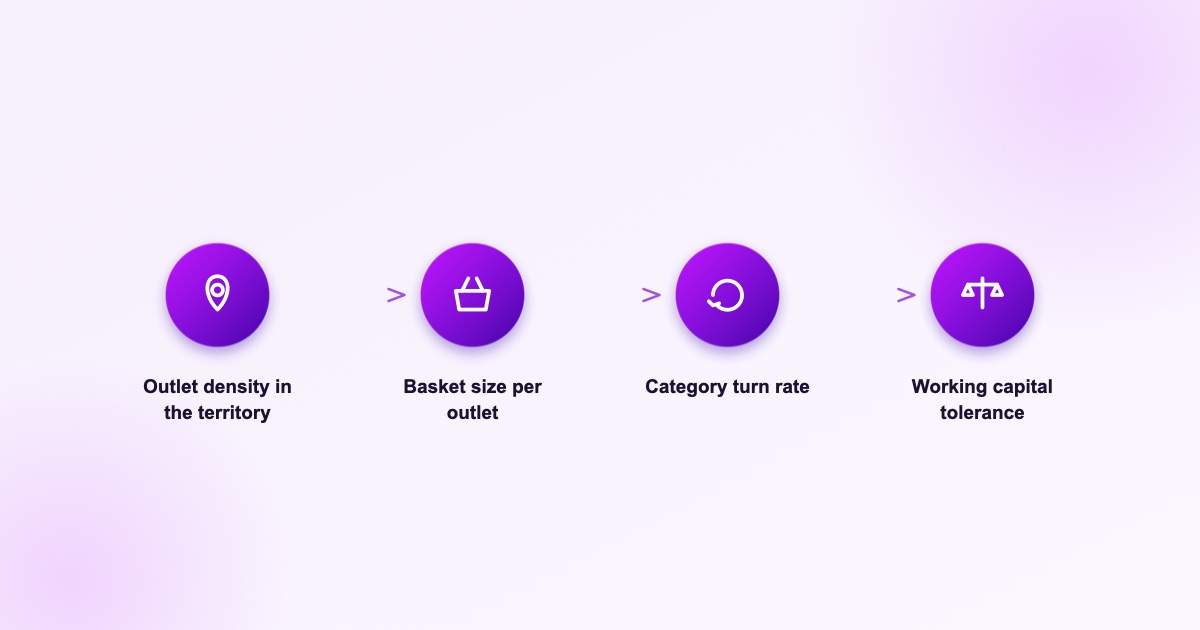
Four variables carry most of the weight in this decision, and notably none of them is "which model does our biggest competitor use." Outlet density determines whether a direct route can be filled efficiently in a single day. Basket size determines whether the margin captured by cutting out the distributor is large enough to justify the fixed cost of a direct team. Category turn determines how much working capital sits in transit at any given time, which matters more for a brand carrying it directly than for a distributor spreading that risk across many brands. And working capital tolerance, frankly, determines how much of this decision is even available to a given company at a given point in its growth.
A fast-turning, low-basket category in a dense urban market can often justify direct coverage even with thin per-unit margin, because volume and turn compensate. The same category in a sparse rural geography almost never can. This is the single biggest reason a blanket direct-versus-distributor policy underperforms a mixed model: the right answer is genuinely different by geography, not just by brand preference.
Running a mixed model without it becoming two disconnected businesses
Most large FMCG networks end up running both models simultaneously, direct in dense urban clusters and premium modern trade, distributor-led everywhere general trade density does the heavy lifting. The risk in a mixed model is not the split itself, it is letting the two sides report through separate systems with separate definitions of availability, separate promotional calendars, and no shared view of what is actually happening at the shelf.
When that happens, a brand can be simultaneously out of stock through its direct channel and overstocked through its distributor channel in the same city, and nobody notices until a quarterly review. The fix is not choosing one model over the other. It is making sure both models feed one commercial view, so a coverage decision in one channel accounts for what is already happening in the other.
Frequently asked questions
No. Direct distribution removes the distributor's margin but adds the full cost of a brand-owned sales team, fleet, and retailer credit. It tends to outperform in dense, high-basket, fast-turning categories and underperform in sparse or low-ticket markets, where a distributor's density and shared working capital carry the model more efficiently.
Working capital. A brand carrying retailer credit directly absorbs a risk that a distributor previously spread across many brands and outlets. In slow-turning or high-basket categories, that working capital exposure can outweigh the margin gained from cutting out the distributor.
A distributor paid on primary billing (sell-in) has less direct incentive to push sell-out at the shelf than the brand does. Without service-level agreements and incentives tied to sell-through, on-shelf availability, and outlet coverage, a distributor-led model can hit its own targets while the brand's shelf performance lags.
Yes, and most large FMCG networks do, typically direct in dense urban and modern trade clusters and distributor-led where general trade density does the heavy lifting. The risk is operational fragmentation: if the two channels report through separate systems, a brand can be out of stock in one channel and overstocked in the other in the same city without anyone noticing.
Outlet density, basket size, category turn rate, and the company's working capital tolerance carry most of the weight. The decision should be made by geography and category, not as a single company-wide policy, since the right answer genuinely differs between a dense urban cluster and a sparse rural territory.
Model your distribution mix before you change it
See how Vxceed helps commercial teams compare direct and distributor-led coverage side by side, using real outlet-level cost-to-serve data instead of a boardroom guess.
Request a demo