Fixing Distributor Fragmentation Without a Full RTM Overhaul
 Team Vxceed · September 2026

Distributor fragmentation almost never announces itself as a crisis. It accumulates quietly, one under-scaled territory at a time, usually as a side effect of market expansion done under time pressure: a distributor signed on to cover a gap quickly, a territory split after a dispute, a legacy relationship kept alive past the point it made commercial sense. None of these decisions looks wrong in isolation. Together, they leave a network with more distributors than it needs, each too small to invest properly in the outlets it serves.
The result is a network that looks fully covered on a map and underperforms on the ground: thin margins keeping distributors from investing in delivery infrastructure, inconsistent service levels across adjacent territories, and a brand that cannot get a clean, consolidated view of its own distribution because the data comes through dozens of disconnected relationships.
How to tell fragmentation from healthy distributor density
Not every market with many distributors is fragmented. Dense, high population geographies can genuinely support a larger number of smaller distributors, each viable in its own right. The distinction worth testing for is scale relative to territory potential: is a distributor small because the territory itself is small and dense, which is fine, or is it small because it was carved out of a larger territory that could support one stronger distributor instead of two struggling ones?
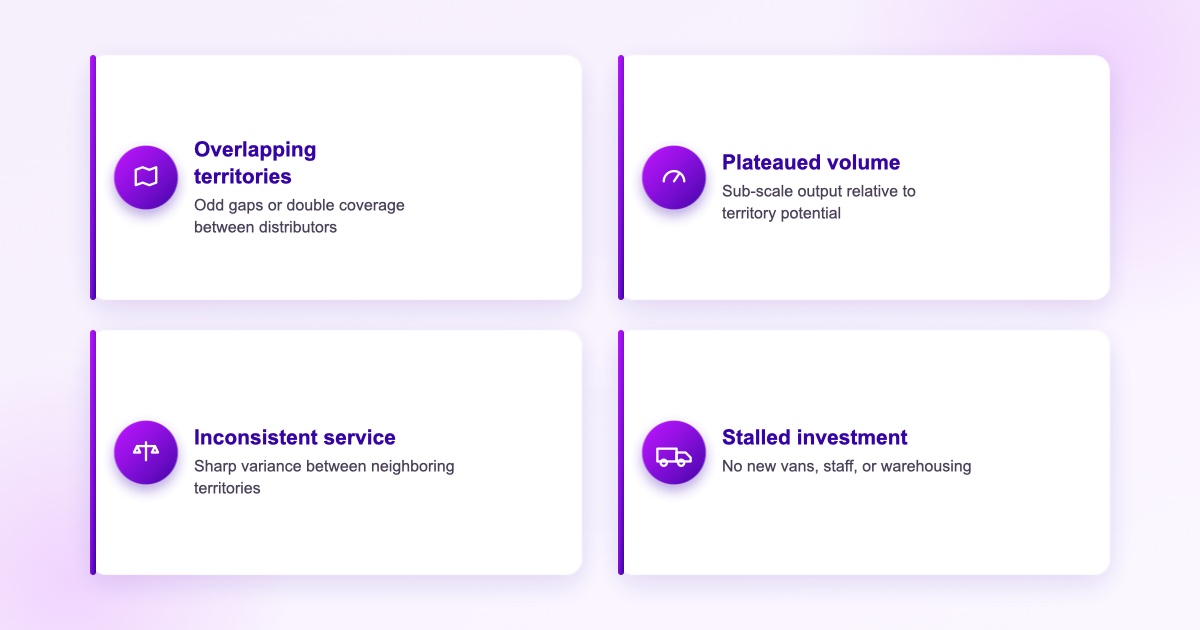
Four signals tend to show up together when the second scenario is happening: territories that overlap or leave odd gaps between them, per-distributor volume that has plateaued well below what the territory should support, service levels that vary sharply between adjacent territories with no obvious market reason, and distributors who have stopped investing in vans, warehousing, or staff because margin at their current scale does not justify it.
Why a full RTM overhaul is usually the wrong first move
The instinct once fragmentation is diagnosed is often to redesign the entire distribution map at once. This is expensive, slow, and risky: every territory in transition is a territory where service levels can slip while a new distributor ramps up, and doing this across an entire network simultaneously multiplies that risk by however many territories are in motion.
A more disciplined approach treats consolidation as a sequence, not an event. Start with the territories where fragmentation is most severe and the fix is least disruptive, typically adjacent sub-scale territories with a natural, willing consolidation partner already in the network. Prove the transition model works there, with service levels protected throughout, before applying it to territories where the transition is harder or the incumbent relationships are more entrenched.
Running the transition without a service-level dip
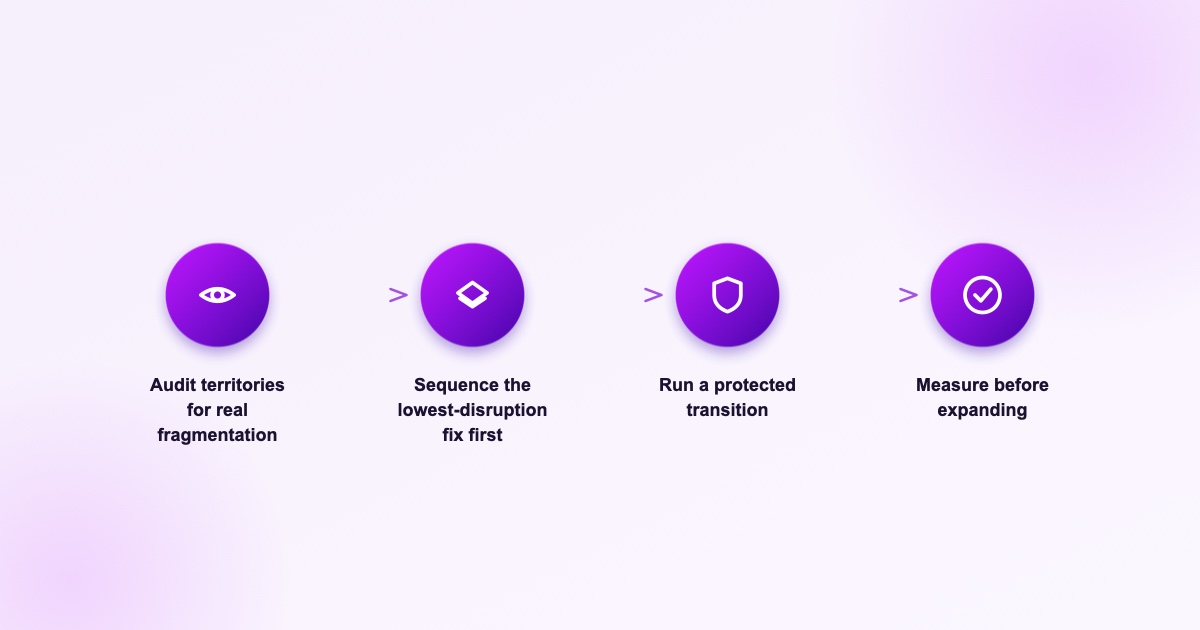
The transition itself is where most consolidation efforts either earn trust for the next phase or poison the well for it. A short overlap period, where the outgoing and incoming distributor both have visibility into the same territory's orders and stock positions, prevents the coverage gap that a hard cutover almost always produces. Distributor onboarding discipline matters here as much as it does for a brand-new relationship, because from the outlet's perspective, this is a new distributor regardless of how experienced that distributor already is elsewhere in the network.
Outlet-level continuity, keeping the same beat schedule, the same order cycle, and ideally the same field rep relationships where possible, does more to protect service levels through a consolidation than any amount of back-office planning. Retailers notice a new face and a changed visit day far more than they notice which company issued the invoice.
What consolidation actually returns
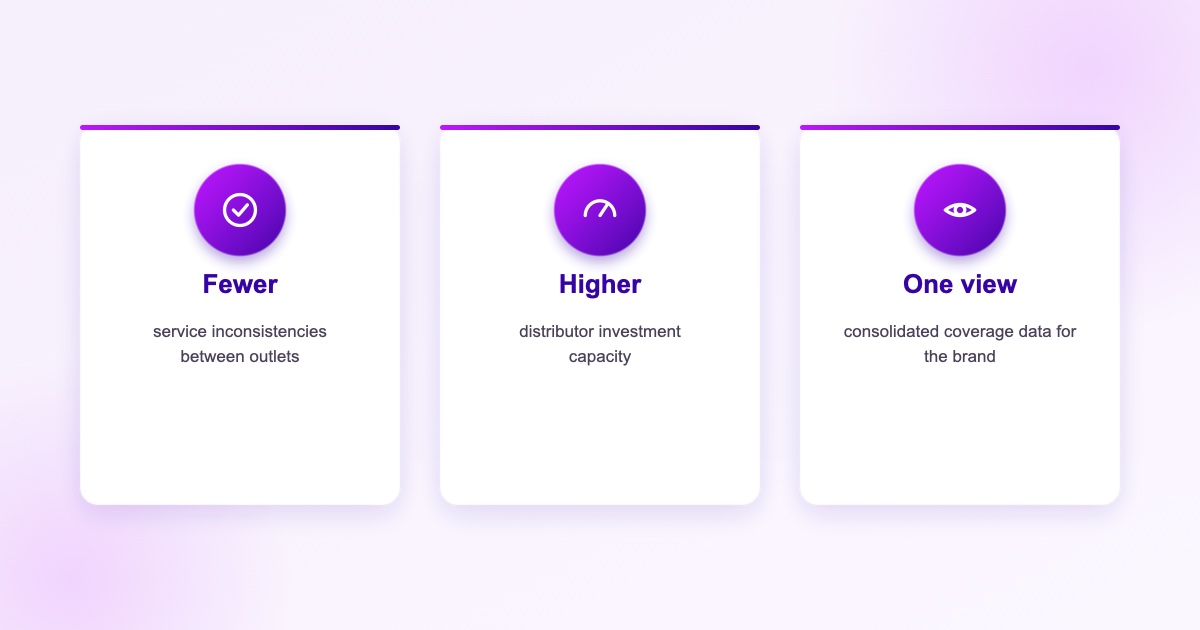
A consolidated territory, run by a distributor with enough scale to justify real investment, tends to show up first in the parts of the business that are hardest to quantify in a business case but easiest to see once fixed: fewer service inconsistencies between neighboring outlets, a distributor willing to invest in a proper vehicle fleet instead of running lean on rented transport, and a brand finally able to get one clean view of coverage instead of reconciling dozens of partial reports.
None of this requires unwinding the entire distribution network at once. It requires being honest about which territories are fragmented for a structural reason and fixing those deliberately, rather than either ignoring the problem or trying to solve it everywhere simultaneously.
Frequently asked questions
Distributor fragmentation is when a route-to-market network has more distributors than its territories can efficiently support, each too small to invest properly in coverage, delivery infrastructure, or service levels. It typically accumulates gradually through market expansion decisions rather than happening as a single event.
Look for four signals together: overlapping or oddly-shaped territories, per-distributor volume plateaued below what the territory should support, service levels that vary sharply between adjacent territories, and distributors who have stopped investing in vans, warehousing, or staff because margin no longer justifies it.
A network-wide redesign puts every territory in transition at the same time, multiplying the risk of a service-level dip. A sequenced approach, starting with the territories where fragmentation is worst and consolidation is least disruptive, protects service levels while proving the transition model works before scaling it.
A short overlap period where both the outgoing and incoming distributor have visibility into the same territory prevents coverage gaps. Keeping the beat schedule, order cycle, and field rep relationships consistent through the transition matters more to outlet-level service continuity than back-office planning alone.
Stronger distributors with enough scale to invest in proper infrastructure, more consistent service levels between neighboring territories, and a single clean data view for the brand instead of reconciling reports across dozens of sub-scale relationships.
See where your distributor territories actually break down
Vxceed helps commercial teams map real outlet-level coverage against distributor territories, so fragmentation gets fixed with data instead of guesswork.
Request a demo