What Is E-Merchandising in CPG, and What Tools Support It?
 Team Vxceed · October 2026
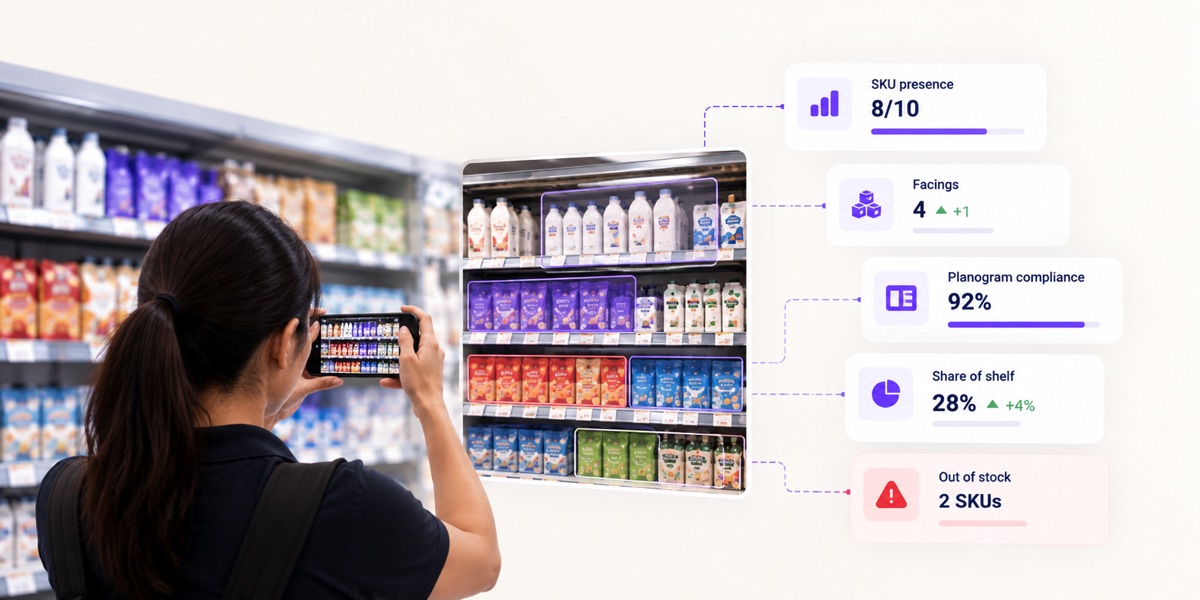
E-merchandising (electronic merchandising) is the use of shelf photos, image recognition and digital planograms to measure and improve how a CPG brand's products appear in stores. Instead of a rep filling in a compliance form, the rep photographs the shelf and software scores it.
The term can also mean merchandising products online in e-commerce. In CPG field execution, it refers to digital auditing of physical store shelves, which is the meaning used here.
What e-merchandising measures
Planogram compliance. Whether products sit where the planogram says they should, with the right number of facings.
Share of shelf. The brand's share of shelf at brand, category and SKU level, measured from the image rather than counted by hand.
Out-of-stocks. Gaps on the shelf that point to on-shelf availability problems, caught while there is still time to reorder.
Displays and materials. Whether secondary displays and point-of-sale materials were set up as briefed.
Competitors. Which competitor SKUs are on the shelf, and how much space they hold.
How e-merchandising works
The rep photographs the shelf during the outlet visit, in the same app used for orders. Blurry, irrelevant or fraudulent photos are flagged at capture, so the rep can retake them before leaving.
Image recognition then identifies each SKU and counts its facings and shelf position. The result is compared with the planogram for that channel, category and outlet tier, and each deviation is scored.
Finally, the rep gets corrective actions while still in the store, and managers see compliance, share of shelf and out-of-stocks on their dashboards the same day.
Why it matters
Manual audits are subjective and hard to verify, so brands running perfect store programmes often cannot prove that execution happened as briefed. E-merchandising applies one standard to every outlet and keeps photo evidence for every audit.
It also turns shelf data into same-day action instead of a report that arrives after the promotion has ended, and gives commercial teams a regular read on competitor activity across the outlets their reps already visit.
What to look for in an e-merchandising tool
Accuracy on your own portfolio. Ask for recognition accuracy measured on your SKUs and packs, not a generic figure.
Speed. Results the rep can act on before leaving the outlet.
Validation at capture. Poor photos rejected in the field, not in the back office.
Planogram management. Planograms by channel, category and outlet tier, versioned and dated.
Part of the visit flow. Audits inside the SFA app reps already use, with no separate login.
Connected to ordering and incentives. Out-of-stocks that can trigger reorders, and scores that can feed retailer loyalty rewards.
Data security. Certified infrastructure, and data residency options where regulations require them.
E-merchandising in Lighthouse
Lighthouse eMerchandising is the e-merchandising module of Vxceed's Lighthouse platform. Shelf audits run inside the same Lighthouse SFA visit flow reps already use. It recognises SKUs with 98% accuracy, processes each shelf photo in under 2 seconds, scores planogram compliance and share of shelf automatically, tracks competitor SKUs, and alerts the rep while they are still in the outlet.
Out-of-stocks found in a shelf audit can trigger reorder prompts through Lighthouse DMS, and compliance scores can feed outlet loyalty rewards. Shelf images and recognition data are processed on ISO 27001 and SOC 2 compliant infrastructure.
Frequently asked questions
E-merchandising is the use of shelf photos, image recognition and digital planograms to measure how a CPG brand's products appear in stores. A rep photographs the shelf during an outlet visit, and software identifies the SKUs, counts facings, checks the layout against the planogram, and calculates share of shelf and out-of-stocks.
A manual audit relies on the rep filling in a form, so scores are subjective and hard to verify. E-merchandising scores the shelf from a photo, applies the same standard at every outlet, keeps the image as evidence, and returns results while the rep is still in the store.
Planogram compliance, share of shelf at brand, category and SKU level, out-of-stocks and on-shelf availability, facings and shelf position, secondary displays and point-of-sale materials, and competitor presence.
No. In e-commerce, merchandising refers to how products are presented on a website or marketplace. In CPG field execution, e-merchandising means digital auditing of physical store shelves.
E-merchandising is usually delivered as an image-recognition module inside a sales force automation or retail execution platform, so shelf audits happen in the same app reps use for visits and orders. Lighthouse eMerchandising, from Vxceed, works this way: audits run inside the Lighthouse SFA visit flow, and out-of-stocks it finds can trigger reorder prompts through Lighthouse DMS.
See every shelf your reps visit, scored automatically
Lighthouse eMerchandising turns each outlet visit into objective shelf data, from planogram compliance to out-of-stocks, inside the app your reps already use.
Request a demo

