Integrated SFA and DMS vs Separate Tools: Which Is Better for FMCG?
 Team Vxceed · November 2026
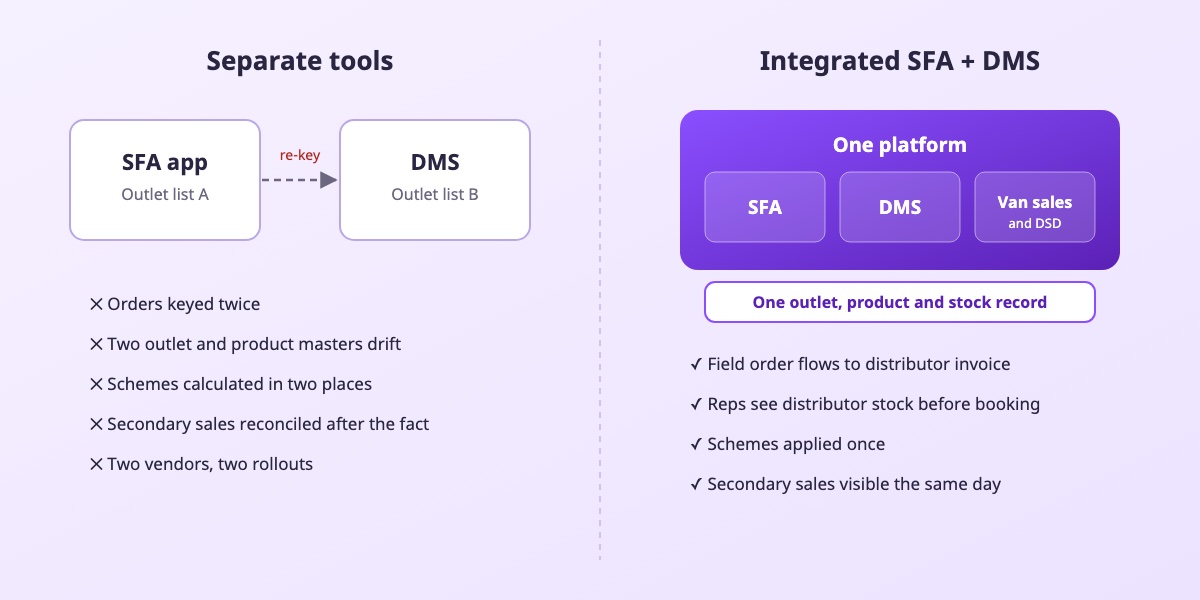
FMCG brands that sell through distributors usually need two systems. Sales force automation (SFA) is the app field reps use to plan visits, take orders and run retail execution at the outlet. A distributor management system (DMS) runs the distributor's side: stock, invoicing, claims, schemes and secondary sales reporting.
The question is whether those two jobs should run on one platform or on separate tools from different vendors, connected by an integration. This guide sets out where separate tools break, what integration changes, and when keeping them separate still makes sense.
Where separate SFA and DMS tools break
Orders are keyed twice. A rep books an order in the SFA app, and someone at the distributor re-enters it in the DMS to invoice it. Every re-keyed order is a chance for a wrong SKU, quantity or price, and a delay before the outlet is served.
Two outlet and product masters drift apart. New outlets, closed outlets, SKU codes and price lists have to be maintained in both systems. Within months the outlet the rep visits and the outlet the distributor bills no longer match one to one.
Schemes are calculated in two places. If the SFA shows the rep one discount and the DMS applies another at invoicing, the retailer disputes the bill and the brand pays the claim.
Reps sell blind. Without live distributor stock in the SFA app, reps book orders the distributor cannot fulfil, and short deliveries surface only after the fact.
Secondary sales are reconciled, not seen. Commercial teams compare what was ordered in the field with what was invoiced by the distributor, often days later and in spreadsheets.
Two vendors, two rollouts. Separate training, support desks, release cycles and offline sync rules, and no single owner when the data does not match.
What an integrated SFA and DMS changes
Order to invoice without re-keying. The order a rep books in the field flows into the distributor's stock and invoicing on the same platform.
One master for outlets, products and prices. A new outlet or price change is made once and is the same for the rep and the distributor.
Schemes applied once. The scheme the rep shows the retailer is the one applied on the invoice and the one the distributor claims.
Reps see distributor stock. Reps can check what the distributor holds before they book, and stock alerts can trigger replenishment.
Secondary sales the same day. Primary, secondary and field data sit in one place, so commercial teams see sell-out by outlet, distributor and SKU without a reconciliation step.
One rollout and one support model. One vendor answers for the whole flow, from the rep's handset to the distributor's ledger.
| Separate SFA and DMS | Integrated SFA and DMS | |
|---|---|---|
| Order to invoice | Re-keyed or synced by a custom integration | Flows directly on one platform |
| Outlet and product master | Maintained twice; drifts over time | One master shared by reps and distributors |
| Schemes and pricing | Configured in two places | Configured once, applied at order and invoice |
| Distributor stock in the rep app | Only if the integration carries it | Visible before the rep books |
| Secondary sales visibility | After reconciliation | Same day |
| Vendors, rollouts and support | Two of each | One |
When separate tools still make sense
You are keeping an SFA you cannot replace. A global mandate or a deeply embedded field app may mean only the DMS is changing.
You only need part of the job. For example, a brand that sells direct with a small team may need SFA but no DMS.
You are phasing the change. Some brands replace the DMS first and move field sales later.
In these cases, insist on the basics: shared outlet and product IDs, near real-time sync of orders, stock and invoices in both directions, a single owner for master data, schemes calculated in one system only, and clear rules for orders captured offline.
Questions to ask a vendor
Does an order booked by a rep reach the distributor's invoice without anyone re-entering it?
Is there one outlet, product and price master, or two that are kept in sync?
Can the rep see distributor stock and the retailer's outstanding balance before booking?
Where are schemes calculated, and does the invoice always match what the rep showed the retailer?
What works offline: the rep app, the distributor app, or both?
Which ERPs does it connect to out of the box?
SFA and DMS on Lighthouse
Vxceed's Lighthouse platform runs SFA, DMS, van sales and primary replenishment on a single data layer, so orders, stock and payments move between modules with no manual handoff or re-entry. Lighthouse SFA and the DMS Lite app work offline, and pre-built connectors cover SAP, Oracle, Microsoft Dynamics 365, Navision and BPICS.
Hindustan Coca-Cola Beverages runs Lighthouse DMS across 2,200 distributors and 6,600 users, with about 500 sub-distributors on DMS Lite (read the case study). In the Philippines, Mega Prime Foods moved to one system for SFA, DMS, van sales and reporting, and digitised 42 distributors in three months against a six-month plan (read the case study).
Lighthouse DMS also connects to an SFA a brand already runs. A global personal care brand in Southeast Asia replaced its legacy DMS with Lighthouse DMS and Central and integrated it with its existing SFA for real-time data sync (read the case study). Lighthouse is priced per use, by the products chosen and the number of users, so brands can start with one module and add the other.
Frequently asked questions
For most FMCG brands that sell through distributors, yes. An integrated SFA and DMS shares one outlet, product and stock record, so field orders reach the distributor's invoice without re-keying, schemes are applied once and secondary sales are visible the same day. Separate tools can work when a brand must keep an existing SFA, but they need a reliable two-way integration and ongoing effort to keep two masters in sync.
Sales force automation (SFA) is the app field reps use to plan visits, take orders and run retail execution at the outlet. A distributor management system (DMS) manages the distributor's stock, invoicing, claims, schemes and secondary sales. Most FMCG brands that sell through distributors need both.
Orders keyed twice, outlet and product masters that drift apart, schemes calculated differently at order and invoice, reps booking orders the distributor cannot fulfil, and secondary sales that can only be seen after reconciliation. Each system also needs its own rollout, training and support.
Yes, if both systems share outlet and product IDs and sync orders, stock and invoices in near real time. A global personal care brand in Southeast Asia replaced its legacy DMS with Lighthouse DMS and Central and integrated it with its existing SFA for real-time data sync.
Yes. Vxceed's Lighthouse runs SFA, DMS, van sales and primary replenishment on a single data layer. Hindustan Coca-Cola Beverages runs Lighthouse DMS across 2,200 distributors and 6,600 users, and Mega Prime Foods digitised 42 distributors in three months on Lighthouse SFA, DMS and van sales.
See SFA and DMS on one platform
Lighthouse connects the order your rep books to the distributor's stock, invoice and secondary sales, with no re-keying in between.
Request a demo

