How AI Is Used in FMCG Sales Planning and Order Recommendations
 Team Vxceed · November 2026
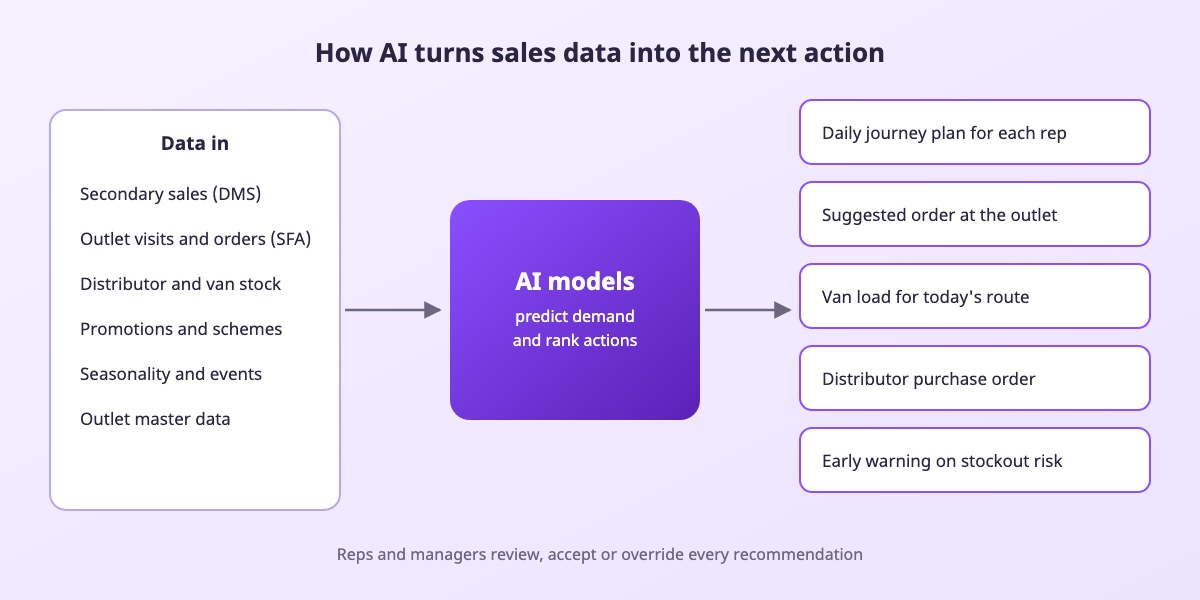
Most FMCG sales planning still runs on fixed beat plans, last month's averages and the rep's memory of what an outlet usually buys. That works until demand moves with a promotion, a season or a competitor, and then it shows up as stockouts in some outlets and excess stock in others.
AI changes the planning step. Models trained on secondary sales, outlet order history, distributor and van stock, promotion calendars and seasonality predict demand at outlet and SKU level, and rank the actions most likely to protect or grow sales. Here is where that shows up across the sales cycle.
Five ways AI is used in FMCG sales planning
1. Daily journey planning. Instead of a fixed weekly beat, each rep gets a daily route shaped by outlet potential, coverage gaps and real-time events, such as a retailer placing an order through a B2B app. High-potential and at-risk outlets move up the list. See outlet tiering for field priorities.
2. Suggested orders at the outlet. The order is pre-filled from the outlet's own buying pattern, so core SKUs are never missed. The rep also sees missing SKUs, eligible promotions and what similar outlets nearby are buying, which is where cross-sell suggestions come from.
3. Van load recommendations. For van sales, each van's load is recommended from predicted demand on that day's route, SKU velocity and shelf life, within weight, cube and temperature limits. See AI van load planning.
4. Distributor order recommendations. Primary orders are suggested every day at distributor and SKU level, from secondary sales, promotions and events, with credit limits and minimum order quantities built in. Area sales managers review and approve them. See AI primary replenishment.
5. Early warnings. Predictive models flag outlets heading for a stockout, distributors at risk of missing target and promotions that are underperforming, while there is still time to act. See Lighthouse Signals.
What AI changes at each step
| Planning step | Without AI | With AI |
|---|---|---|
| Which outlets to visit | Fixed weekly beat | Daily plan ranked by potential and risk |
| What the outlet orders | Rep's memory or last order | Pre-filled order plus cross-sell suggestions |
| What the van carries | Standard load every morning | Load matched to the day's route demand |
| What the distributor buys | Monthly averages or gut feel | Daily suggested primary order for approval |
| When problems surface | After the stockout or month-end | Flagged ahead, while there is time to act |
What data AI needs
Secondary sales by outlet and SKU, usually from the DMS. Visit and order history from the SFA app. Distributor and van stock. Promotion and scheme calendars. Clean outlet and product master data.
The data does not need to be perfect to start. Recommendations improve as more of the network is digitised, and models can be rolled out region by region as data matures. The biggest single dependency is a reliable outlet and SKU master, because every recommendation is made at that level.
Keep people in the loop
AI recommendations work best as suggestions that reps and managers can see the reasons for, accept or override. A rep who knows an outlet is closed for a festival should be able to skip it, and an area manager should approve a suggested distributor order rather than have it sent automatically.
Measure the effect the same way you would a promotion: compare outlets, routes or distributors using recommendations against similar ones that are not, over the same period.
What to look for in an AI sales planning tool
Inside the apps people already use. Recommendations in the rep's order screen and the manager's approval queue, not a separate dashboard.
Explainable. Each suggestion shows why, such as velocity, a promotion or what similar outlets buy.
Works offline. Suggested orders and journey plans available on routes with no signal.
Constraint-aware. Credit limits, minimum order quantities, van capacity and shelf life built in.
Measurable. Uplift tracked against a comparison group, not assumed.
AI planning and order recommendations in Lighthouse
Lighthouse Recommendations is the AI layer across Vxceed's Lighthouse SFA, DMS, van sales and loyalty modules. It analyses outlet performance, real-time inventory, promotion schedules and field context to produce AI-guided journey plans, Smart Lists that pre-fill orders, next best action prompts, cross-sell suggestions, van load recommendations and daily primary order suggestions. Vxceed reports 5 to 10% sales growth from AI-guided actions and a 15 to 20% reduction in capital trapped in excess inventory.
Lighthouse Signals adds early warnings, predicting which outlets need attention 48 to 72 hours ahead. For van sales, Vxceed's AI load planning reports 7 to 8% higher daily route sales from fewer stockouts and 40 to 60% fewer expiries in freshness-sensitive categories.
Frequently asked questions
AI predicts demand at outlet and SKU level from secondary sales, order history, stock, promotions and seasonality, then turns it into actions: a daily journey plan for each rep, suggested orders at the outlet, van loads matched to the route, suggested distributor orders and early warnings on stockout risk.
They are suggested orders generated from data rather than memory. At the outlet, the order is pre-filled from the outlet's buying pattern, with missing SKUs, eligible promotions and cross-sell items added. For distributors, a daily primary order is suggested at SKU level, with credit limits and minimum order quantities applied, for a manager to approve.
Secondary sales by outlet and SKU, visit and order history, distributor and van stock, promotion calendars and clean outlet and product master data. Recommendations improve as more of the distributor network is digitised.
No. Good tools show why each recommendation was made and let reps and managers accept or override it. AI does the ranking and the arithmetic; people keep the final decision.
AI recommendations are usually built into SFA and DMS platforms so they appear in the rep's order screen and the manager's approval queue. Lighthouse Recommendations, from Vxceed, works this way across Lighthouse SFA, DMS, van sales and loyalty, and Lighthouse Signals adds early warnings 48 to 72 hours ahead.
Put AI-guided actions in every rep's hands
Lighthouse Recommendations turns your sales, stock and promotion data into journey plans, suggested orders and van loads inside the apps your teams already use.
Request a demo

